[Test] Only For Development
Hello there, are you QA? Then ok. If not, go out please.
Ask two brokers what a building is worth and you may get two different numbers. Ask them what it trades at, and you will usually get the same one: a cap rate. It is the shorthand of commercial real estate, the figure that compresses a rent roll, an operating statement, and a market's mood into a single percentage you can say out loud in a meeting.
The capitalization rate — cap rate, in practice — is the ratio of a property's net operating income to its value or price, expressed as a percentage. A 6% cap rate means the property produces six cents of NOI for every dollar of value. The arithmetic is trivial. The judgment behind the inputs is where the work actually lives.
The Formula and Its Three Forms
The relationship has one equation and three uses, depending on which two variables you already know.
- Solve for the rate: Cap Rate = NOI ÷ Value. You know the price and the income, and you want to know how the deal is priced relative to the market.
- Solve for value: Value = NOI ÷ Cap Rate. This is the direct capitalization method, and it is how most quick valuations get done.
- Solve for income: NOI = Value × Cap Rate. Less common, but useful when you are backing into the income a seller must be claiming to justify an asking price.
A worked example makes it concrete. A property generates $600,000 of net operating income and is offered at $10,000,000. Divide 600,000 by 10,000,000 and you get 0.06, or a 6.0% cap rate. Flip it around: if comparable assets in that submarket are trading at 7.5%, dividing $600,000 by 0.075 implies a value closer to $8,000,000 — and you have just found the gap between the asking price and the market.
What Counts as NOI, and What Does Not
A cap rate is only as good as the income figure on top of it, and NOI is a defined term, not a loose one. Getting it wrong is the single most common way a new analyst produces a confident number that is quietly meaningless.
What belongs in NOI. Start with gross potential rent, subtract vacancy and credit loss, add recoveries and other income, then subtract operating expenses: property taxes, insurance, utilities, repairs and maintenance, management fees, and a reserve for replacements where market convention includes it.
What stays out. Debt service is excluded — this is the whole point. Cap rate measures the property's performance, not the buyer's financing. Also excluded: capital expenditures, tenant improvements and leasing commissions, depreciation, income taxes, and anything specific to a particular owner's structure.
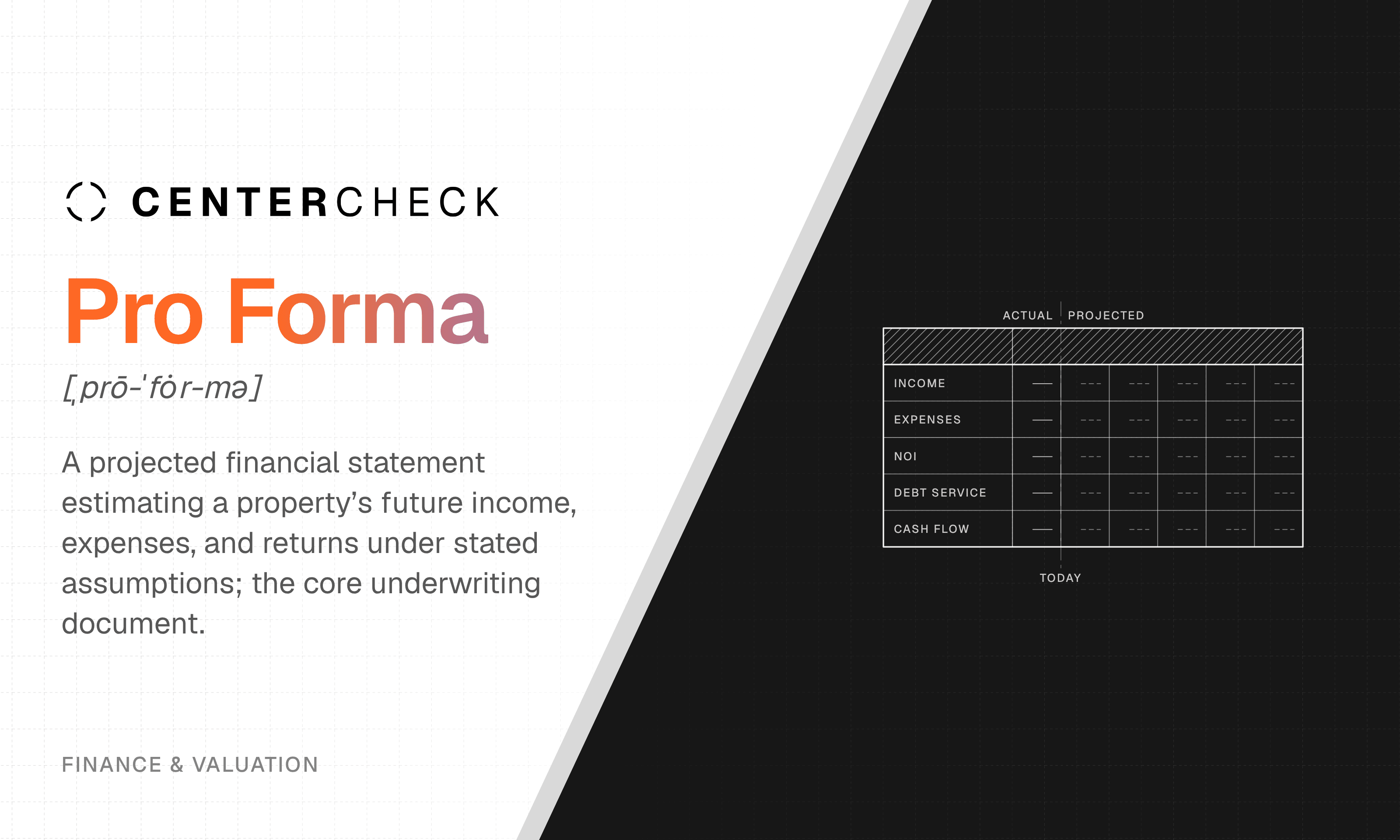
Which period you use matters. A trailing-twelve NOI, a forward twelve-month projection, and a stabilized pro forma NOI will each produce a different cap rate on the same building. Sellers tend to quote the flattering one. When you receive a cap rate, your first question should always be which NOI it sits on.
Reading the Number: High Versus Low
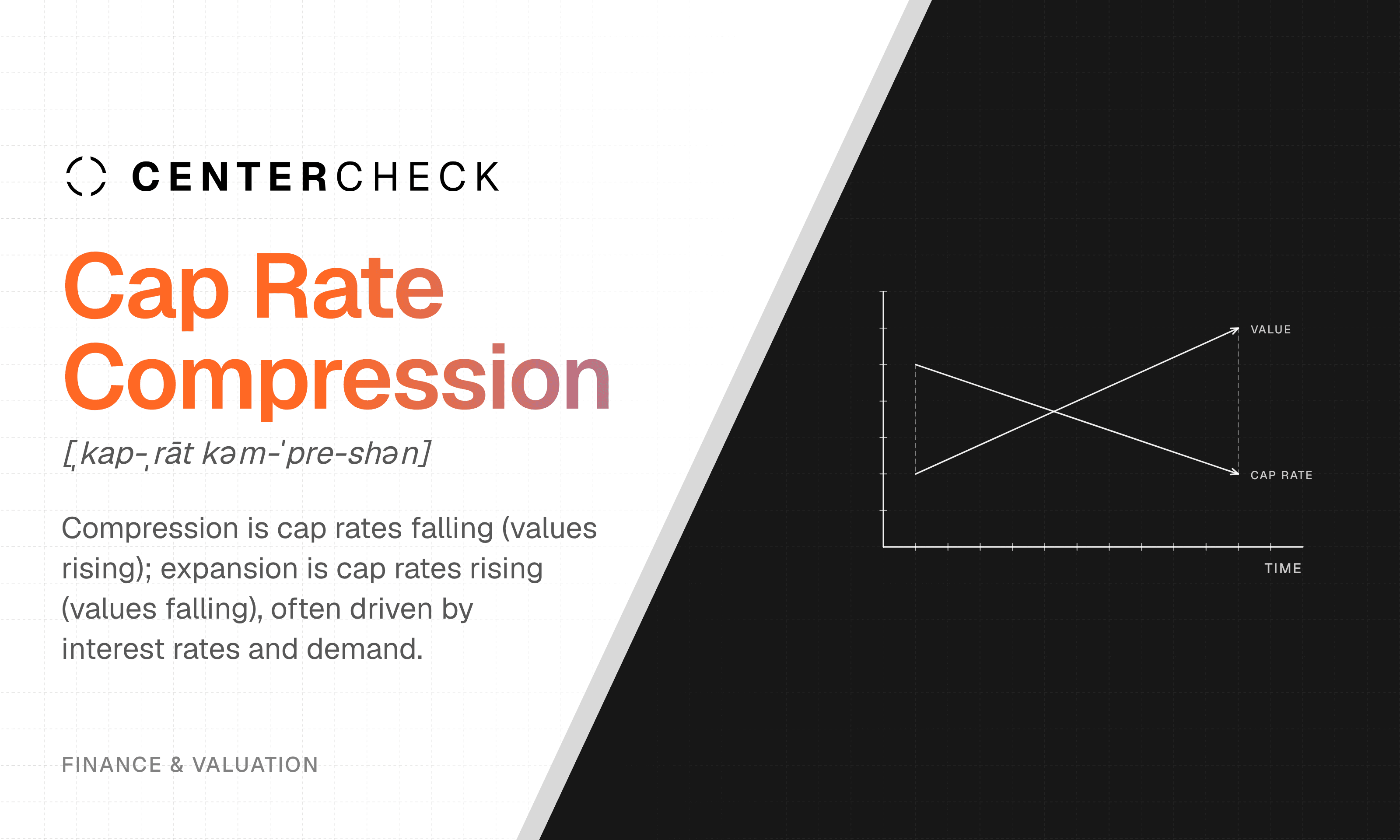
Because value sits in the denominator, cap rates move inversely to price. A lower cap rate means a higher price per dollar of income, which generally reflects lower perceived risk, stronger growth expectations, or both. A higher cap rate means the market is demanding more current income to take the asset on.
| Cap Rate | Value at $600K NOI | Typically Signals |
|---|---|---|
| 4.5% | $13.3 million | Prime asset, deep market, strong rent growth |
| 6.0% | $10.0 million | Stabilized, average risk profile |
| 7.5% | $8.0 million | Older asset or secondary submarket |
| 9.0% | $6.7 million | Vacancy, credit, or capital needs priced in |
Notice how much value swings for a small change in rate. Between 6.0% and 6.5% on this property sits roughly $770,000 of value. Half a point is not a rounding difference; it is a negotiation.
Where Cap Rates Actually Come From
A cap rate is not calculated in isolation. It is observed. The most defensible cap rate comes from recent, genuinely comparable sales: similar asset class, similar location, similar tenancy and lease structure, similar time period. You derive the rate from what buyers paid, then apply it to the income of the asset in front of you.
Two other sources are worth knowing. Broker and appraisal surveys publish quarterly ranges by market and property type, which is useful for sanity-checking but too coarse for pricing a specific deal. And there is the build-up approach: a cap rate can be understood as a risk-free rate plus a risk premium, minus expected growth. That framing explains why cap rates tend to widen when interest rates rise and compress when investors are optimistic about rents.
What a Cap Rate Will Not Tell You
The cap rate answers exactly one question well: what unlevered yield does this income stream produce at this price, in the first year? Everything past that first year is outside its scope.
A cap rate is a snapshot of a single year's yield, not a measure of what an investment will return over time.
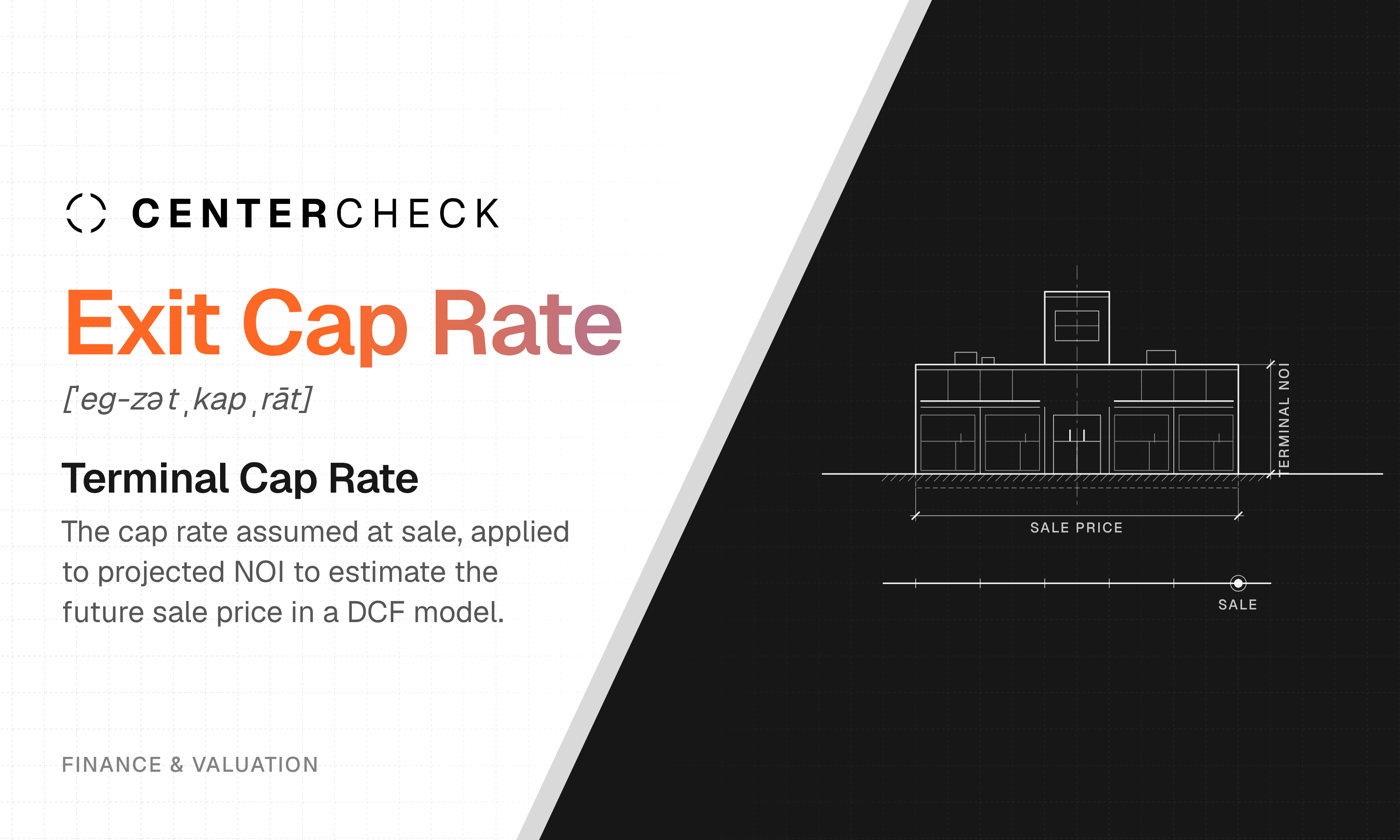
It ignores leverage entirely, so two buyers with different debt terms will see very different equity returns from the same cap rate. It ignores future cash flow, so a building with fifteen-year flat leases and one with staggered rollover to market rents can price identically and perform nothing alike. It ignores capital needs, meaning a roof replacement due next year never touches the number. And it ignores the exit, which is often where the majority of a deal's return is actually made.
This is why the cap rate is a screening tool and a pricing convention rather than an underwriting conclusion. For anything past a first pass, you move to a discounted cash flow, an internal rate of return, and a cash-on-cash figure that reflects the actual capital stack.
Putting It to Work
For an analyst, the discipline is in the inputs: normalize the NOI yourself, state the period it covers, and never accept a rate without knowing the income behind it. For a broker, the discipline is in the comparables: a cap rate quoted without support is an opinion wearing a percentage sign.
Used well, the cap rate does something genuinely valuable. It puts a suburban office building, a grocery-anchored retail center, and an industrial warehouse on the same axis, so you can ask which one the market is pricing most aggressively — and whether you agree.

Follow Us