What Is NPV in Real Estate? Formula and Example
NPV is the present value of future cash flows minus the price paid. See how it sets a maximum bid on a shopping center.
Definition
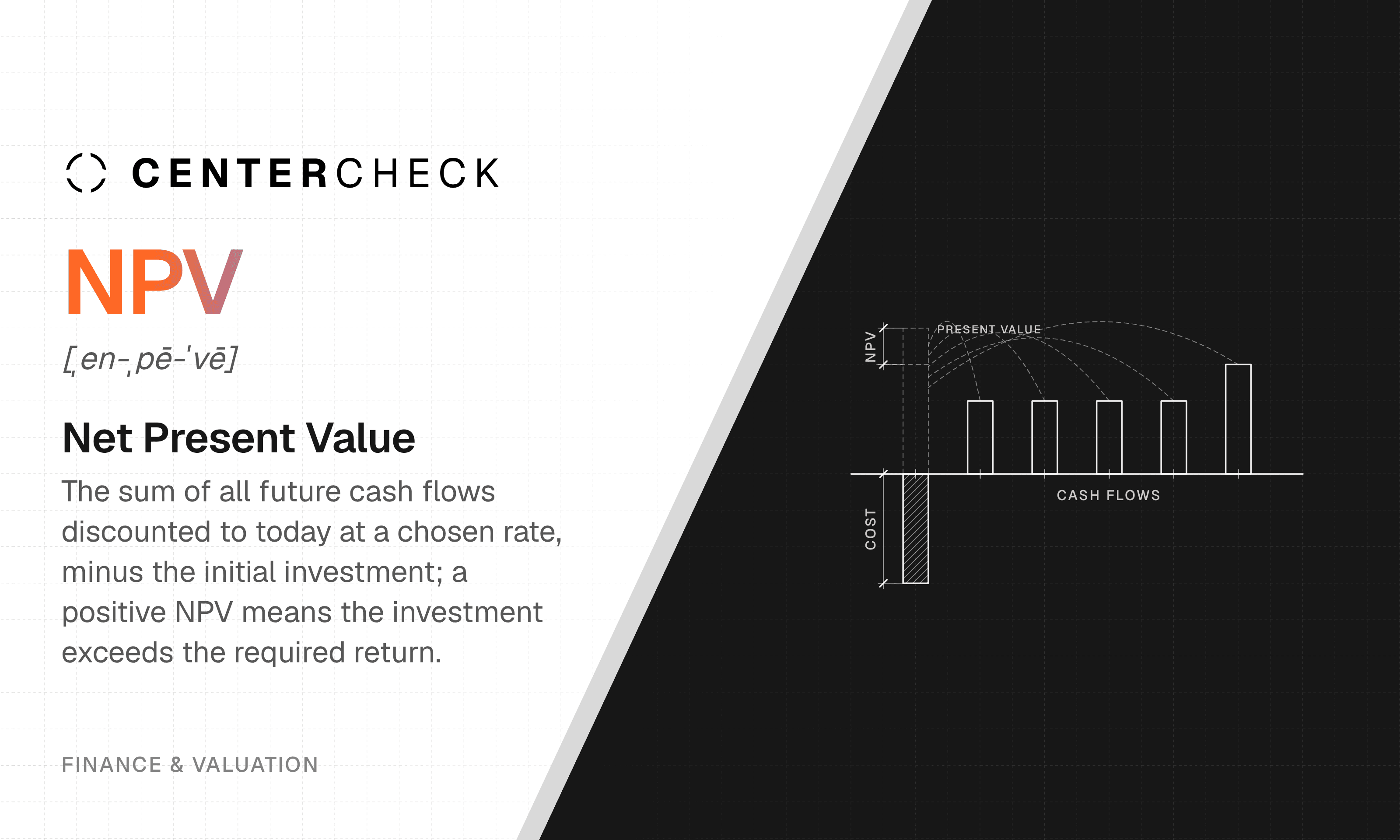
Net present value is the sum of an investment’s future cash flows discounted to today at a required return, minus the price paid. A positive NPV means the deal earns more than the hurdle. A negative one means it falls short.
Formula
NPV = Σ CFₜ ÷ (1 + r)ᵗ − initial investment.
Example
The center’s projected cash flows are worth $20,680,369 at an 8.5% hurdle. Bought at $20,500,000, NPV is +$180,369. At the $21,500,000 asking price it is −$819,631. Raise the hurdle to 9.5% and the $20,500,000 offer turns to −$630,597.
In practice
Buyers use it to set a walk-away price, the point where NPV is zero. Owners compare holding, selling and refinancing in dollars. Developers test whether a project creates value over cost.
Watch for
NPV is only as meaningful as the discount rate behind it, and it says nothing about efficiency: $500,000 of value on a $5 million deal is a different result from the same sum on $50 million. In retail the anchor is the swing factor. Anchor tenant performance data and trade area demographics show whether the grocer that drives traffic will renew. CenterCheck’s retail property due diligence data puts observed spend behind that judgment.
Related terms
IRR · DCF · Discount Rate

Follow Us