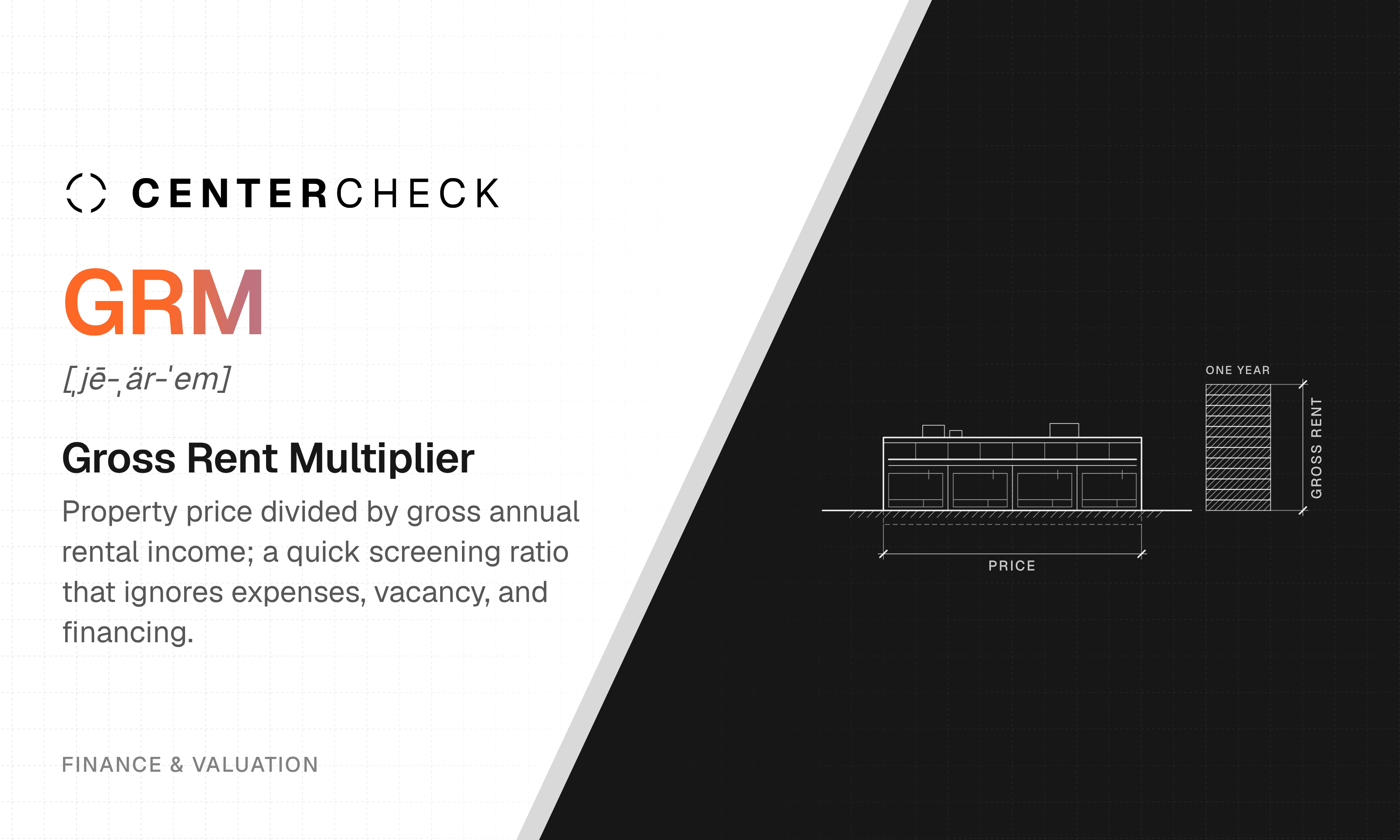
What Is a Gross Rent Multiplier (GRM)?
GRM is price divided by gross annual rent. See a strip center example and why GRM misleads when lease structures differ.
Definition
The gross rent multiplier is a property’s price divided by its gross annual rental income. It shows how many years of gross rent the price represents and ignores expenses, vacancy and financing. It is a screen, not a valuation.
Formula
GRM = price ÷ gross annual rent.
Example
Two 30,000 square foot strip centers are each priced at $6,500,000 and each collect $620,000 of gross income, a GRM of 10.5. Center A has triple-net leases and absorbs $165,000 of expenses: NOI of $455,000, a 7.0% cap rate. Center B has modified gross leases, absorbs $225,000 and earns $395,000, a 6.1% cap rate. At a 7.0% cap rate, Center B is worth about $860,000 less. GRM saw no difference.
In practice
Brokers use it to sort comps and talk pricing with small-property owners. Investors sort listings before ordering financials. Institutional buyers rarely use it.
Watch for
Inconsistent definitions of gross rent, with or without recoveries. The same multiple means different things when tenant sales are rising and when they are falling, so retail broker tools now pair the ratio with sales per square foot data. CenterCheck’s store level estimates serve that purpose.
Related terms
Cap Rate · NOI · Going-In Cap Rate

Follow Us