What Is an Equity Multiple? Formula and Example
Equity multiple is total distributions over equity invested. See a levered shopping center example and why multiple and IRR differ.
Definition
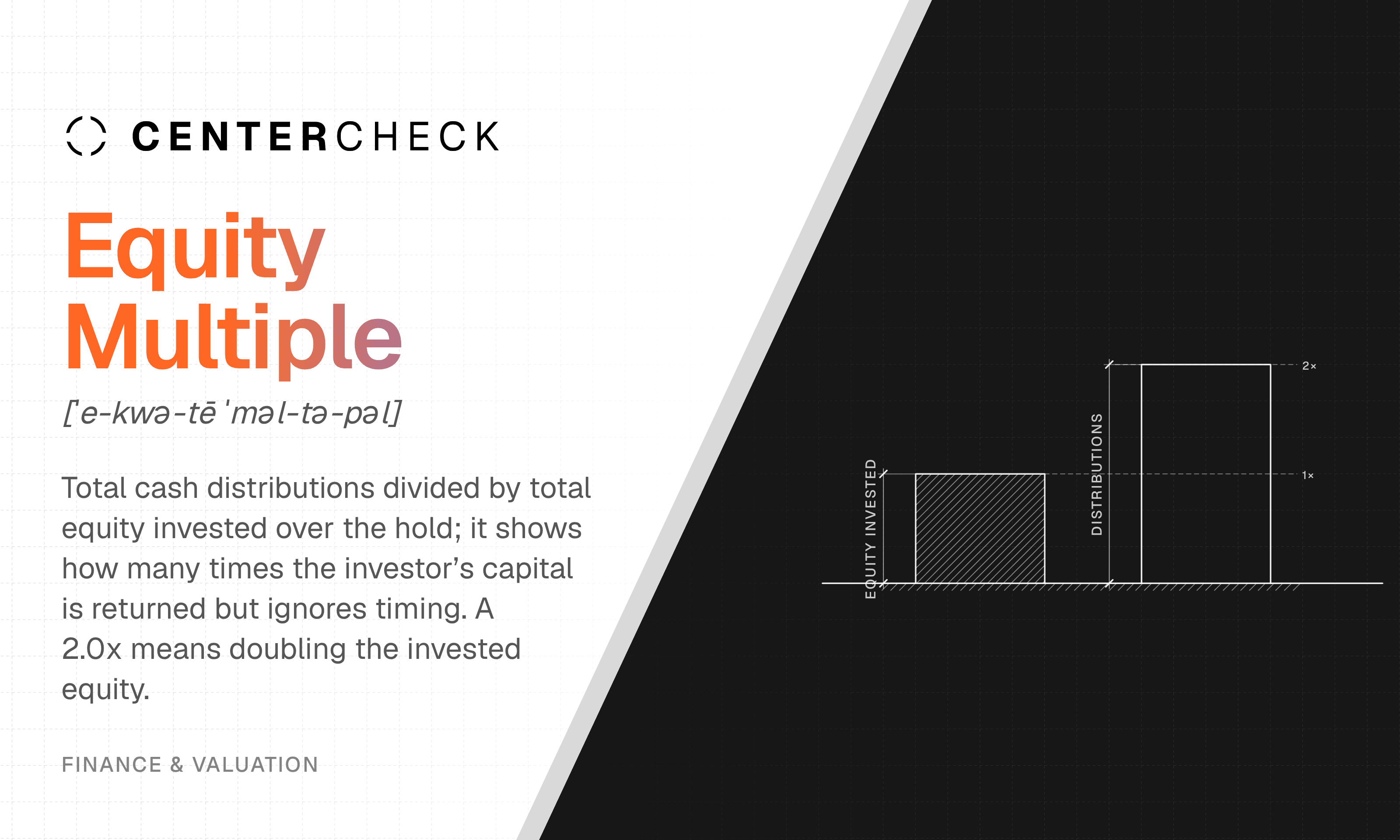
The equity multiple is total cash returned to an investor over the life of a deal, including sale proceeds, divided by total equity invested. A 2.0x multiple means the investor doubled the money. It ignores how long that took.
Formula
Equity multiple = total distributions ÷ total equity invested. ROI equals the multiple minus one.
Example
Same center, same 60% loan, equity of $8,600,000. Levered cash flow over five years totals $3,355,985. Net sale proceeds of $21,772,404 less a loan balance of $11,480,390 return $10,292,014. Total distributions of $13,648,000 make a 1.59x multiple. The levered IRR is about 10.9%. Earn the same 1.59x over ten years and the IRR drops to about 4.7%.
In practice
Limited partners screen sponsors on it. Waterfalls often set promote hurdles on a multiple as well as an IRR. Committees use it to confirm a high IRR is not hiding a small profit.
Watch for
Never compare multiples across different hold periods. Net multiples after fees and promote sit well below gross. The result depends on tenants lasting the hold. An alternative data provider for physical retail, such as CenterCheck, offers store level spend estimates that narrow the range of tenancy outcomes.
Related terms
IRR · Cash-on-Cash Return · NPV

Follow Us