What Is a Discount Rate in Real Estate?
The discount rate converts future cash flows to present value. See how to build one from Treasuries and a risk premium.
Definition
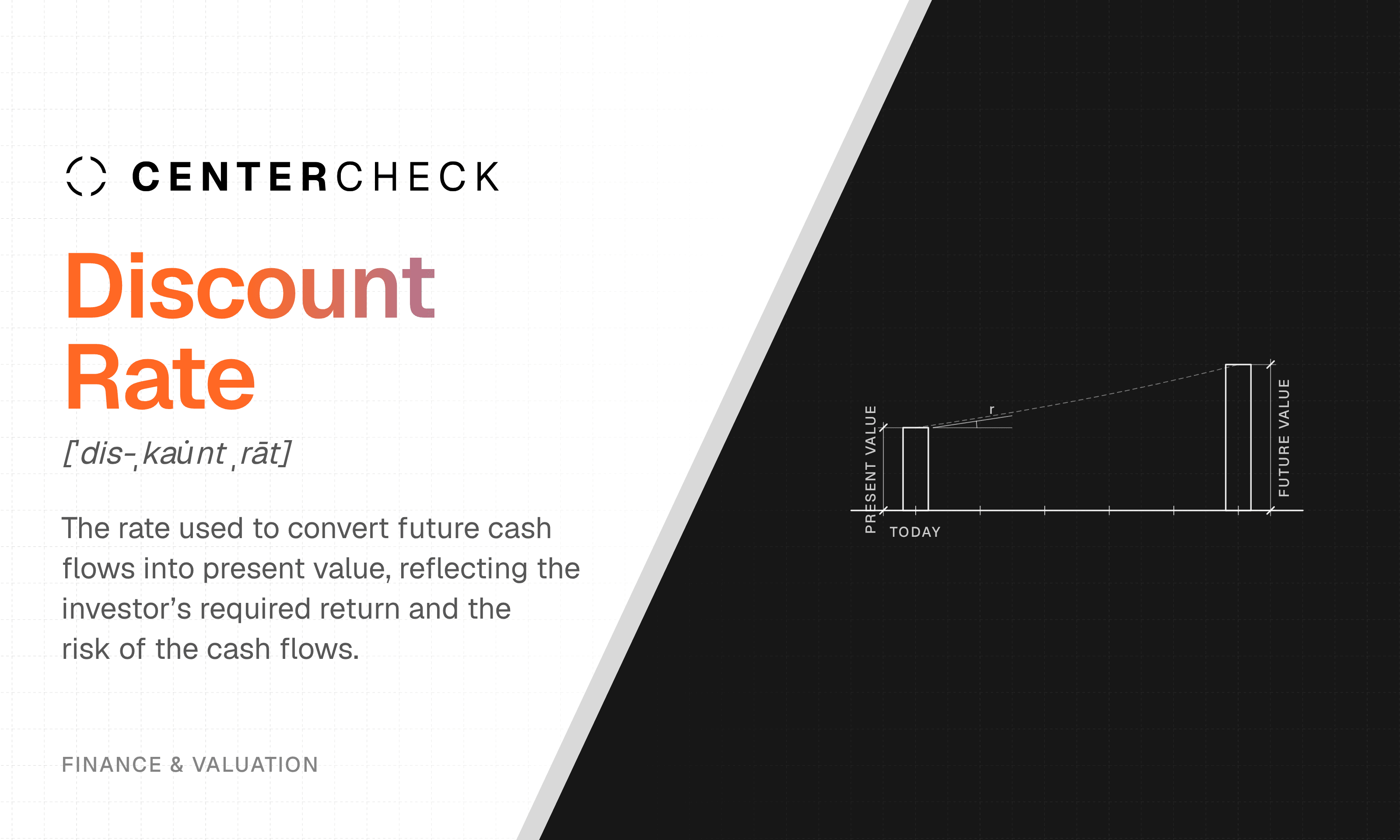
A discount rate is the annual rate used to convert future cash flows into present value. It reflects the return an investor requires: a risk-free yield plus a premium for the risk, illiquidity and uncertainty of the property’s income. A higher rate produces a lower value.
Formula
Discount rate = risk-free rate + risk premium. As a check, discount rate ≈ cap rate + expected long-run NOI growth.
Example
With the 10-year Treasury near 4.6% in mid-2026 and a 3.9% premium for a stabilized grocery-anchored center in a secondary market, the rate is 8.5%. At that rate the center is worth $20,680,369. At 9.5% it is worth $19,869,403, a drop of 3.9%.
In practice
Appraisers draw rates from investor surveys. Funds set hurdles by strategy, core to opportunistic. Lenders check whether a sponsor’s assumed return matches the risk.
Watch for
Copying a survey rate without adjusting for the actual tenancy. Double-counting risk with both conservative cash flows and a high rate. Retail cap rates have historically moved about 78 basis points for every 100 in the 10-year Treasury, more than any other sector (CBRE Econometric Advisors). Consumer spend data by location, including CenterCheck’s store level estimates, supports a premium above or below the survey average.
Related terms
DCF · NPV · IRR · Cap Rate

Follow Us