What Is DSCR? Debt Service Coverage Explained
DSCR is NOI over annual debt service. See a shopping center example, an anchor-loss stress test and 2026 lender benchmarks.
Definition
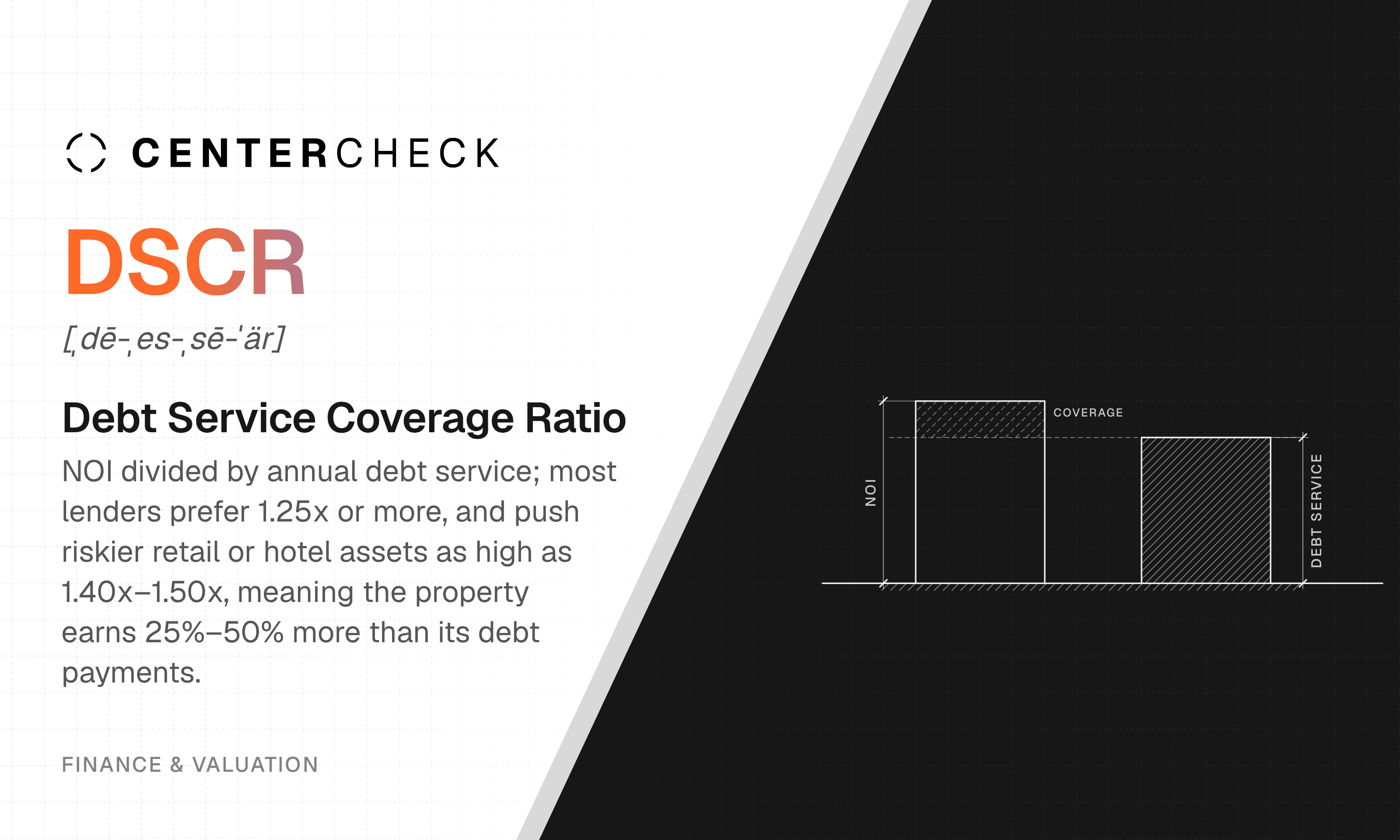
The debt service coverage ratio is net operating income divided by annual debt service, principal and interest. It measures how comfortably a property’s income covers its loan payments. Most lenders require at least 1.25x. Riskier retail and hotel assets often need 1.35x to 1.50x.
Formula
DSCR = NOI ÷ annual debt service.
Example
The center earns $1,620,000 of NOI. A $13,325,000 loan at 6.25% over 30 years costs $984,536 a year: DSCR of 1.65x. If the grocery anchor goes dark and NOI falls $400,000 through lost rent, recoveries and co-tenancy reductions, DSCR drops to 1.24x, below a 1.25x covenant. NOI can fall 39% before coverage reaches 1.00x. On interest-only terms the same loan shows 1.95x.
In practice
Lenders size loans with it: maximum debt service equals NOI divided by required coverage. Covenants trigger cash sweeps when it slips. CMBS analysts watch it for loans heading into trouble.
Watch for
Interest-only flatters it, which is why 2026 CMBS retail loans averaged 1.85x (Trepp) against 1.43x for closed loans overall (CBRE). It is a one-year view that says nothing about an anchor expiring in year three. Lenders now add each tenant’s health ratio, rent plus recoveries over sales, which CenterCheck’s store level sales estimates make measurable even when tenants do not report.
Related terms
Debt Service · Debt Yield · LTV · Amortization

Follow Us