What Is Amortization in Commercial Real Estate?
Amortization is the scheduled repayment of principal. Compare 25-year, 30-year and interest-only loans and their balloons.
Definition
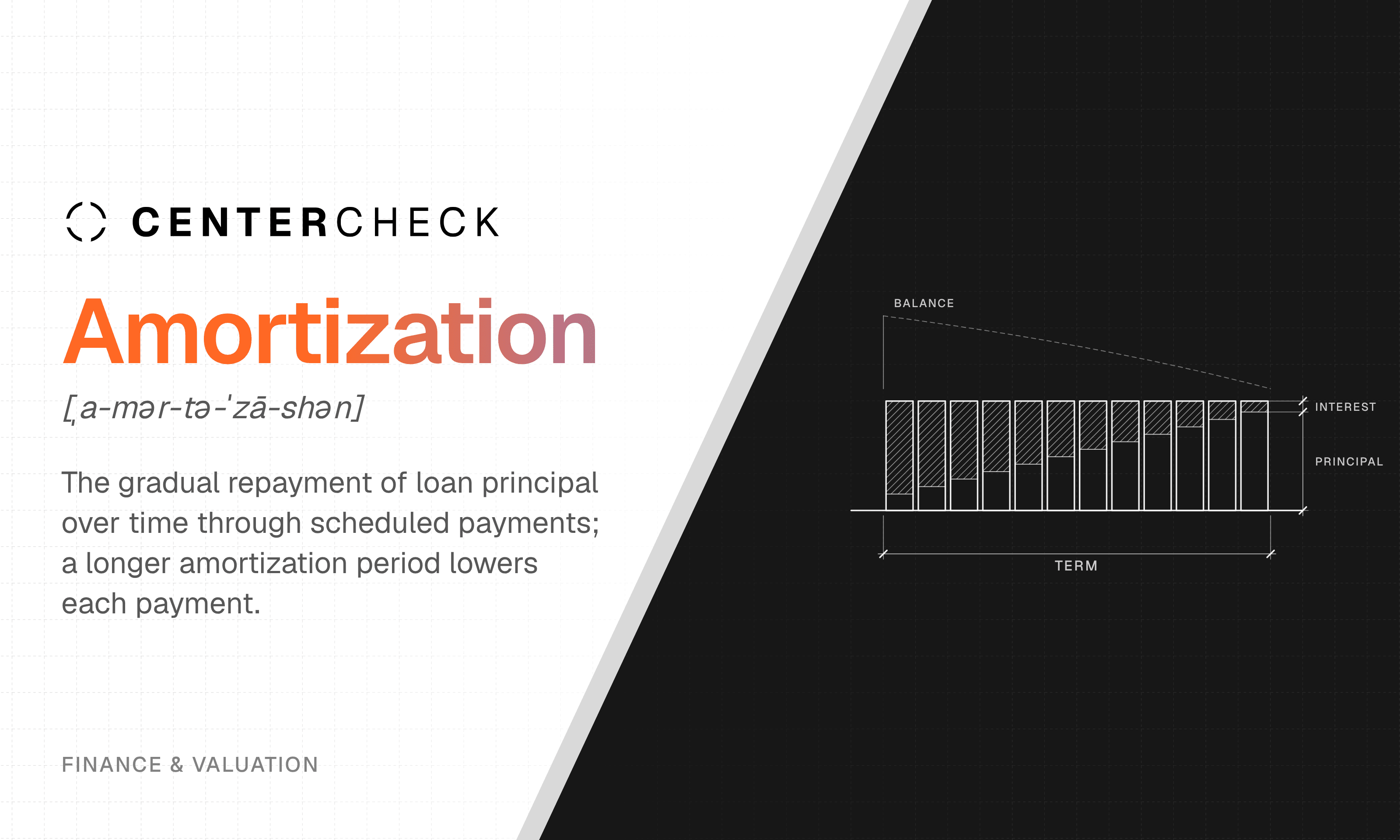
Amortization is the scheduled repayment of loan principal over a set period. A longer period lowers each payment but builds equity more slowly and leaves a larger balance at maturity. Most commercial mortgages amortize over 25 or 30 years and mature in five, seven or ten, ending in a balloon.
Formula
Remaining balance after k payments = L(1 + i)ᵏ − P × ((1 + i)ᵏ − 1) ÷ i, where P is the monthly payment.
Example
$13,325,000 at 6.25% with a ten-year term. Interest-only: $832,813 a year, full balance due. Thirty-year schedule: $984,536 a year, $11,224,446 left, 84% of the original. Twenty-five-year: $1,054,796 a year, $10,251,736 left, 77%. Moving from 30 to 25 years costs about $70,000 a year and cuts the balloon by roughly $973,000; DSCR on $1,620,000 of NOI goes from 1.65x to 1.54x.
In practice
Lenders require faster amortization on older or riskier assets, often shorter for retail than multifamily. Borrowers trade cash flow today against refinance risk at maturity. Investors count paydown as part of total return.
Watch for
Confusing term with amortization and meeting the balloon unprepared. Assuming a refinance on the same terms. Prepayment penalties. How much amortization a retail loan needs depends on how long the income lasts; retail underwriting data on tenant performance, including CenterCheck’s estimates, informs that call.
Related terms
Debt Service · DSCR · LTV

Follow Us