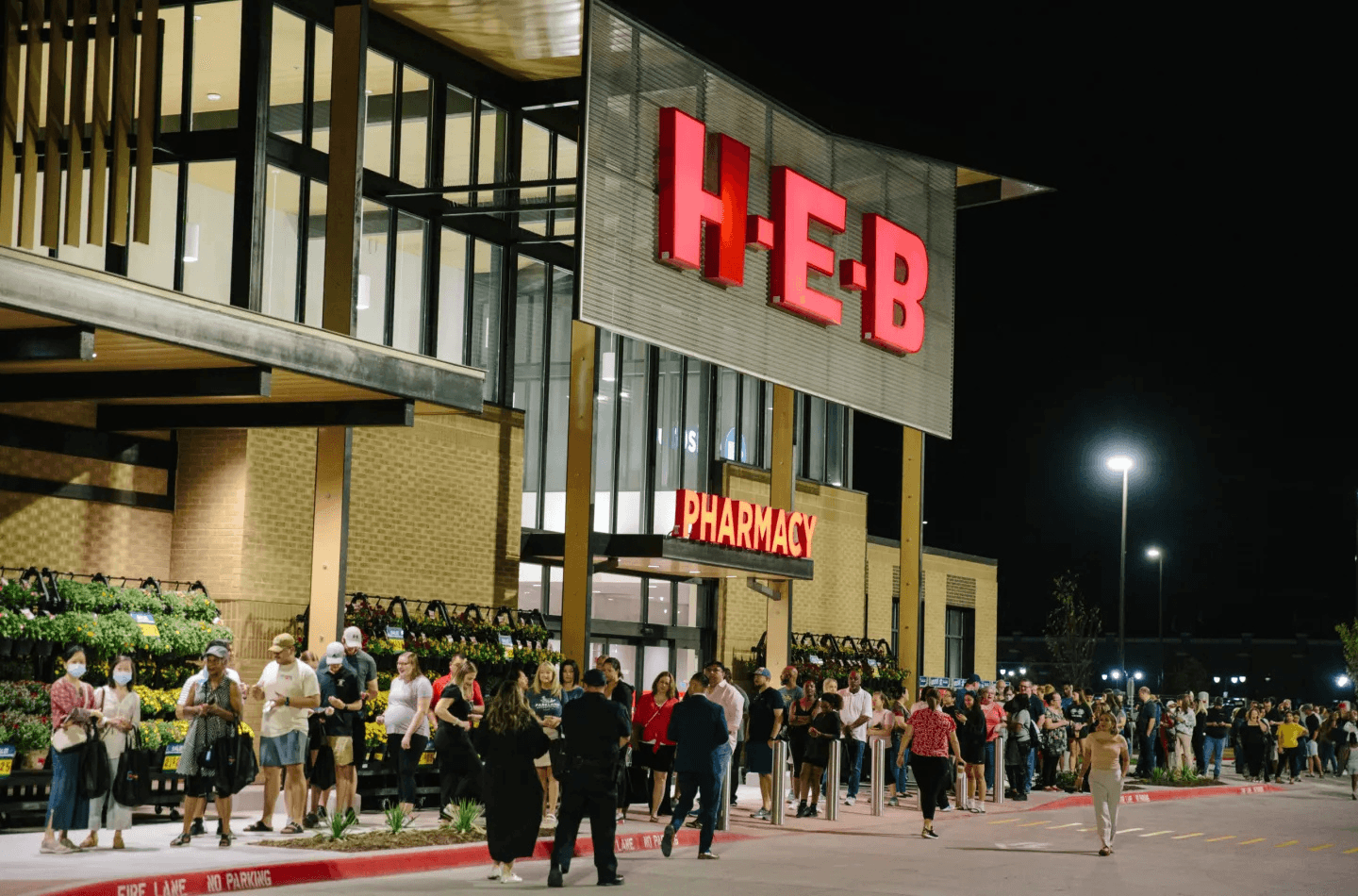
Where H-E-B Is Growing Fastest
Store-level performance shows the Texas grocer gaining momentum across suburban Houston, San Antonio, and other high-growth markets
H-E-B’s strength has never been defined by store count alone. The Texas grocer has built its reputation by understanding local customers, adapting stores to individual markets, and creating locations that function as neighborhood destinations rather than interchangeable boxes.
CenterCheck’s store-level data shows that several of H-E-B’s busiest locations are continuing to grow, even from already substantial customer bases. The strongest momentum appears across suburban Houston, San Antonio, and select regional markets where population growth, household formation, and strong local brand loyalty are supporting continued demand.
The data also reveals an important distinction: H-E-B’s largest stores are not necessarily its fastest-growing stores. Some mature locations continue to attract the most customers, while several suburban stores are producing stronger year-over-year gains.
Suburban Houston Leads H-E-B’s Growth
Among the top-performing locations shown in CenterCheck’s data, H-E-B’s Vintage Market store recorded the strongest year-over-year customer growth, increasing approximately 3.4% while serving nearly 1.15 million customers.
The Shadow Creek Ranch location followed closely, growing approximately 3.2% and attracting roughly 1.16 million customers. Located in the Houston-area community of Pearland, the store benefits from a market characterized by continued residential development, family formation, and access to several major employment centers.
H-E-B’s Webster location also posted approximately 2.5% growth, reaching nearly 1.2 million customers. Its performance reinforces the broader strength of the Houston metropolitan area, where H-E-B has established deep market penetration across urban, suburban, and coastal communities.
Together, these locations suggest that some of H-E-B’s greatest opportunities are emerging outside Houston’s traditional urban core. The strongest growth is occurring in communities where residential expansion, family-oriented demographics, and everyday shopping demand intersect.
San Antonio Remains a Foundational Market
H-E-B’s San Antonio location on Valley Hi Drive ranked first among the stores displayed, attracting approximately 1.31 million customers while growing about 2.5% year over year.
That combination matters. High-growth percentages are easier to produce from a small customer base. Generating continued growth while already serving more than 1.3 million customers demonstrates the durability of H-E-B’s position in its home market.
San Antonio remains one of the company’s most important regions, supported by long-standing customer loyalty and a store network built around the needs of individual neighborhoods. The Valley Hi location’s performance indicates that mature markets can continue to produce meaningful growth when the retailer remains deeply connected to local demand.
For landlords and retail developers, the finding also illustrates the difference between market saturation and market strength. A dense store network does not necessarily limit performance when population growth and customer loyalty remain strong.
Growth is Not Limited to Texas’ Largest Cities
H-E-B’s Jones Crossing location near College Station attracted approximately 1.18 million customers and grew about 0.9%. Another College Station store generated approximately 1.1 million customers while posting modest positive growth.
Brownsville also appeared among the chain’s highest-performing locations, serving approximately 1.15 million customers and growing roughly 0.9%.
These markets are important because they demonstrate the breadth of H-E-B’s appeal. The company is not dependent solely on Texas’ largest metropolitan areas. College towns, border communities, and regional population centers can also support substantial store traffic.
H-E-B’s localized merchandising and community-based operating model may be especially valuable in these markets, where consumer preferences can differ significantly from those found in Dallas, Houston, Austin, or San Antonio.
Not Every High-Volume Store is Accelerating
The Plano location ranked second by customer volume, attracting approximately 1.29 million customers, but its year-over-year customer count declined by roughly 0.6%.
That does not necessarily indicate weak store performance. Plano remains one of the highest-volume locations in the chain. However, the decline highlights why retailers and real estate executives should evaluate both scale and trajectory.
A store can remain highly productive while experiencing slowing growth because of competitive openings, market maturity, customer redistribution, construction disruptions, or changes in nearby shopping behavior. Conversely, a smaller store may represent a greater expansion opportunity if its customer base is accelerating.
For H-E-B, Plano is also strategically significant because North Texas remains a major expansion market. Performance across individual Dallas–Fort Worth stores will provide an early indication of how effectively the company can translate its dominance elsewhere in Texas into sustained growth in a more competitive grocery market.
H-E-B’s Fastest-Growing Locations
Based on the leading stores visible in CenterCheck’s trailing-12-month data, the strongest year-over-year customer growth included:
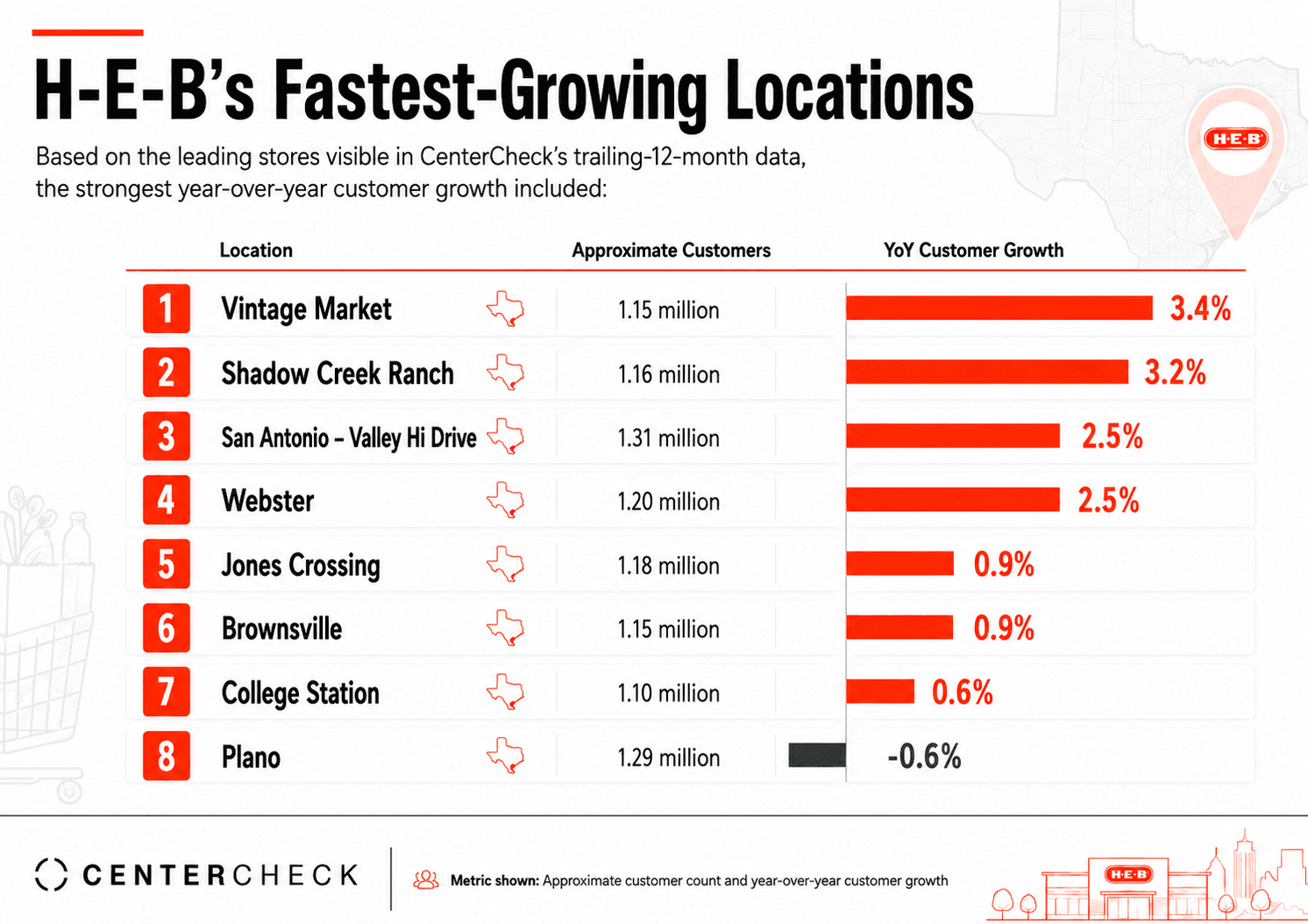
The ranking is based on the locations displayed in the available CenterCheck view and should not be interpreted as a complete ranking of every H-E-B store.
What the Data Means for Retail Real Estate
H-E-B’s growth provides several lessons for retailers, landlords, and developers.
First, suburban population growth continues to create meaningful grocery demand. Locations such as Vintage Market and Shadow Creek Ranch show how residential expansion can support higher customer activity even after a store has become established.
Second, mature markets can continue to outperform. San Antonio demonstrates that longevity and market penetration do not automatically eliminate growth. Strong customer loyalty can allow leading stores to keep expanding from already large bases.
Third, store-level performance matters more than market-level assumptions. Two stores operating under the same banner and within the same metropolitan region can follow very different trajectories. Understanding those differences can help retailers make better expansion decisions and help landlords evaluate the true drawing power of an anchor tenant.
Finally, customer volume should be considered alongside growth. The best opportunities may not always be the stores with the largest existing customer bases. They may be the locations where demand is accelerating most rapidly.
A Localized Growth Story
H-E-B’s recent performance is not defined by one market or one type of consumer. Its growth is distributed across established cities, emerging suburbs, college communities, and regional markets.
The strongest gains, however, are concentrated in places where demographic growth and local relevance reinforce one another. That is particularly evident around Houston, where multiple high-volume stores continue to add customers.
For H-E-B, the opportunity is not simply to open more stores. It is to identify the communities where the brand can become part of the local shopping routine and then operate each location in a way that reflects the market around it.
That is also the larger lesson for retail real estate: growth is rarely uniform across a portfolio. It happens store by store, trade area by trade area, and customer by customer.

Follow Us
Recent Blog Posts
Read the Blog
CenterCheck 2026 Review: Details & Features
25 min read

A&E’s $600M Loan Default Highlights Rent-Regulated CMBS Struggles
10 min read
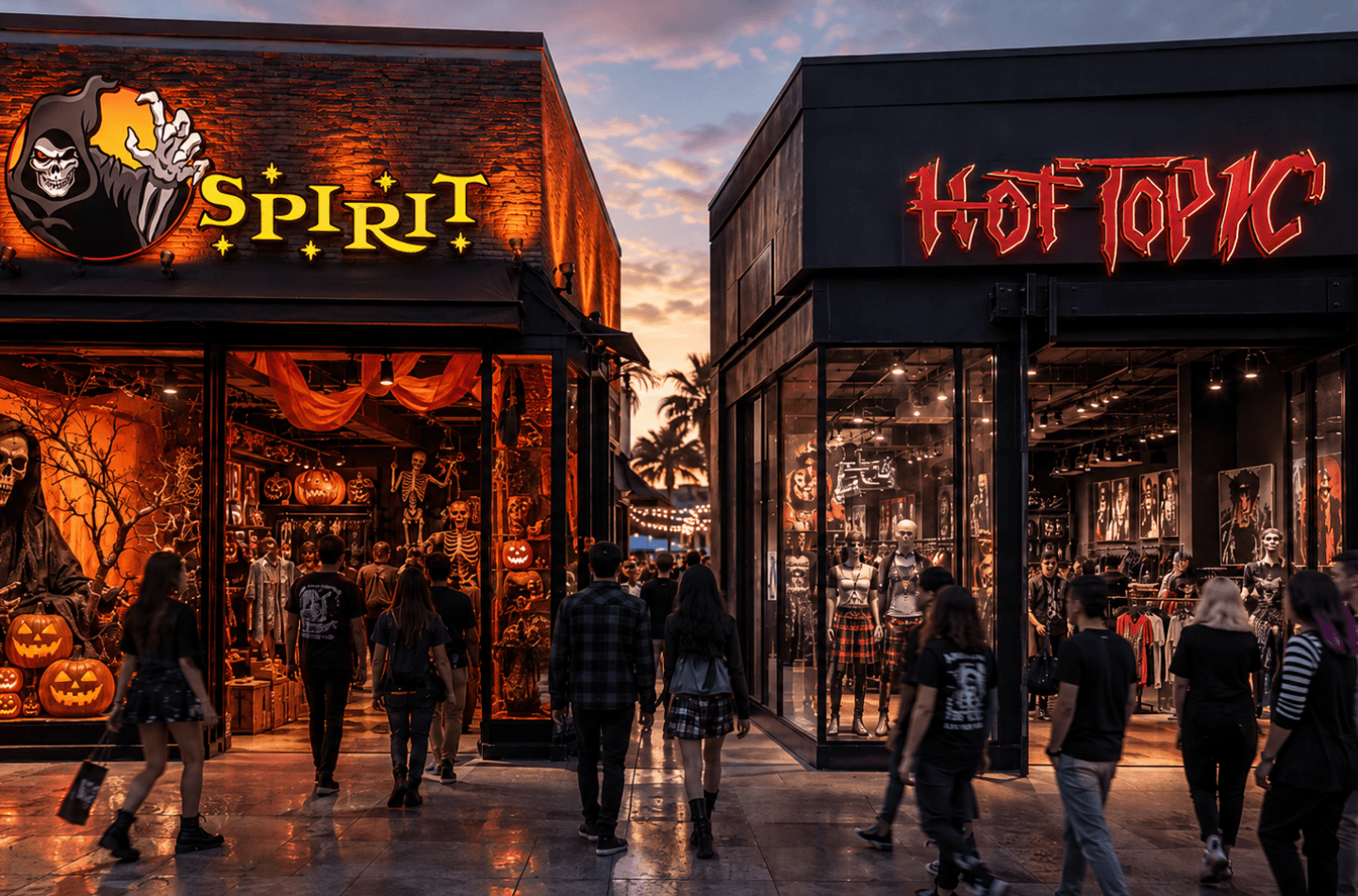
Spirit Halloween Is Acquiring Hot Topic. Here’s What Retail Owners Should Watch For
10 min read

How Comic-Con 2026 Impacted Retail Sales in San Diego: 10 Findings for Retail Real Estate
10 min read