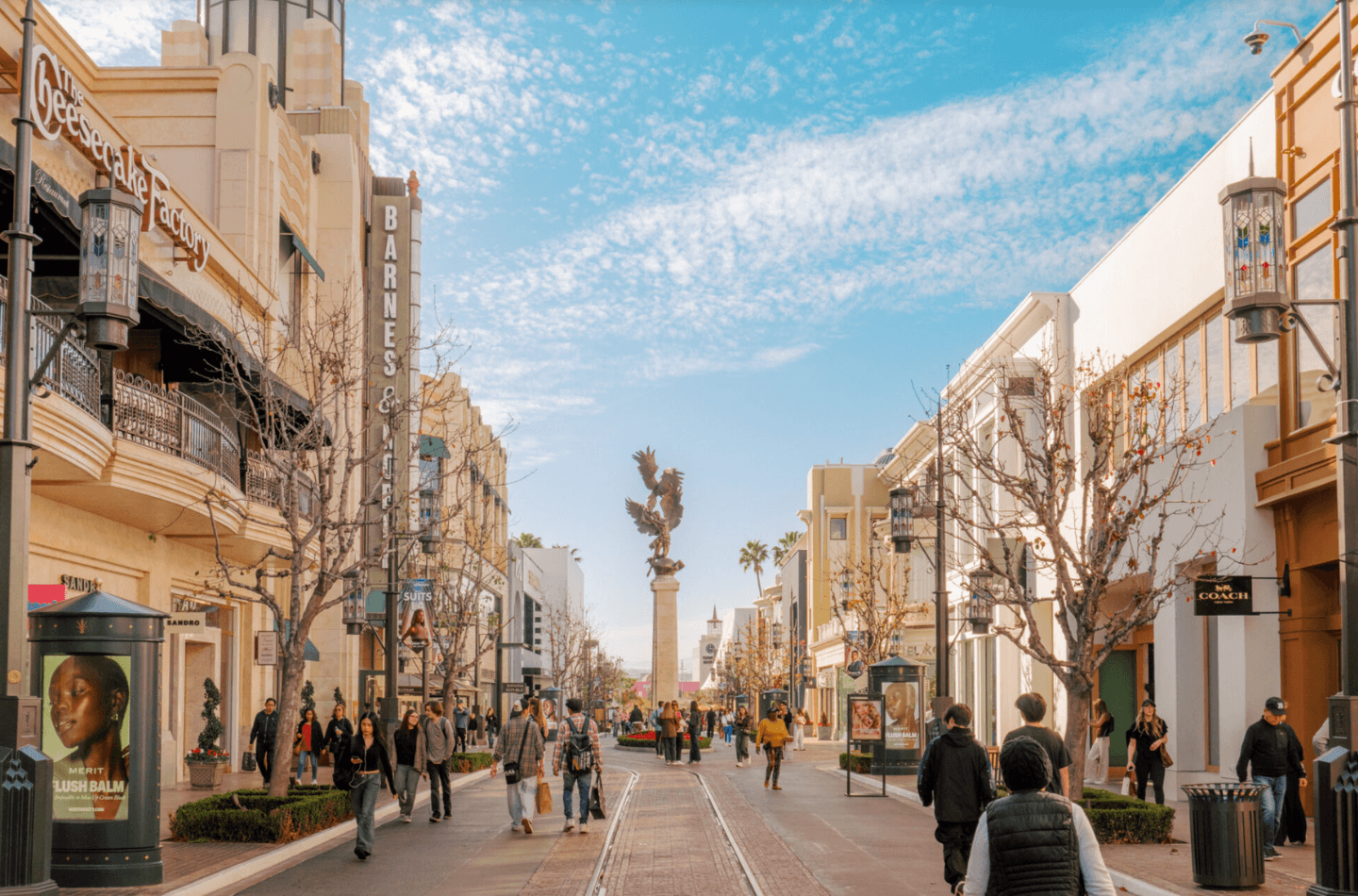
What Makes a Good Retail Center? How The Grove’s Tenant Mix Drives Cross-Shopping
CenterCheck data shows that The Grove’s strength is not simply tenant variety. It is the way complementary retailers, restaurants, and destinations generate repeat local demand and encourage customers to make multiple purchases during one visit.
What makes a good retail center?
Is a great shopping center defined by the number of retailers it brings together—or by how thoughtfully those retailers complement one another and give customers more reasons to explore?
The strongest retail properties accomplish both. They create enough variety to give consumers multiple reasons to visit, while arranging the tenant mix so that one purchase can naturally lead to another, increasing time on property.
The Grove in Los Angeles offers a useful example of that model. CenterCheck estimates that the open-air shopping center generated approximately $98 million in card sales during the first half of 2026, up 14% during the same period in 2025.
For retailers, like Apple, Nike, Gap, Aritzia, Barnes & Noble, and others, that growth is more than a topline performance signal. It suggests that The Grove continues to attract meaningful consumer demand and create an environment where multiple tenants can benefit from the same visit. A retailer evaluating the property is not only considering its own storefront, but also the surrounding customer base, the strength of neighboring brands, the potential for cross-shopping, and the likelihood that shoppers will remain on-site long enough to make additional purchases.
More importantly, the data indicates that The Grove functions as a connected retail ecosystem. Technology, apparel, beauty, books, dining, and other consumer categories do not operate as isolated storefronts. They appear to support broader shopping journeys across the property.
That is increasingly relevant as open-air retail becomes one of the industry’s most important formats. CBRE expects continued demand and rent growth at well-located open-air centers, while JLL has noted that shoppers increasingly value outdoor environments and that food and beverage tenants have become essential traffic drivers.
The Grove, which is owned and operated by Caruso, is positioned as an open-air shopping, dining, and entertainment destination.
Local Consumers Form the Foundation of The Grove’s Sales
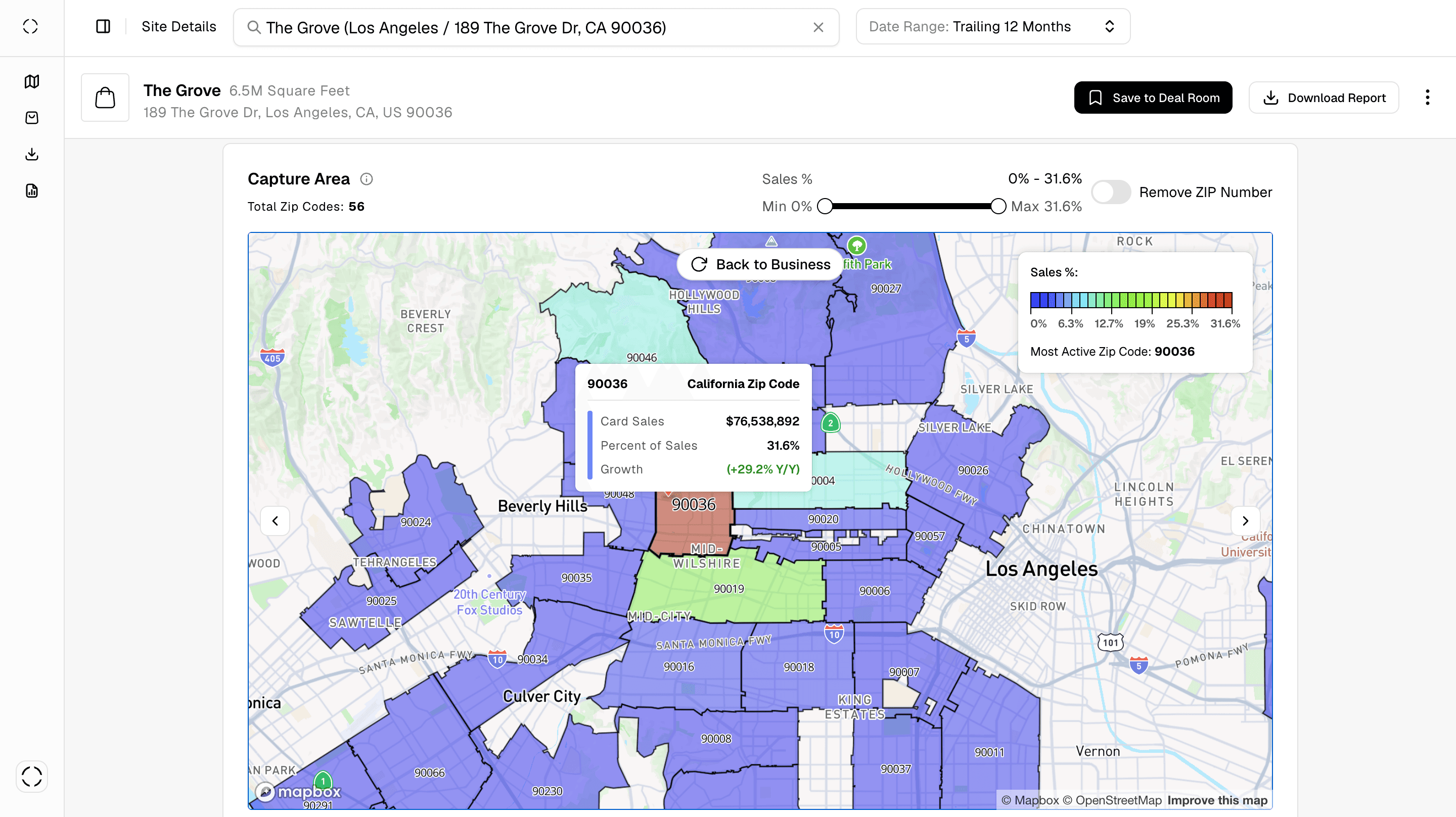
The most important insight in the data may be the strength of The Grove’s immediate trade area.
Approximately 41% of sales came from consumers in ZIP code 90036, where the property is located. Another 14% came from nearby ZIP code 90019.
Collectively, these two ZIP codes represented approximately 55% of estimated sales.
That concentration demonstrates that The Grove’s economic activity is not dependent solely on tourists or occasional destination visitors. The property is supported by consumers living in the surrounding community who can return regularly for shopping, meals, services, entertainment, and social occasions.
This is one of the defining characteristics of a strong shopping center. Destination appeal can attract attention, but nearby consumers create frequency.
A customer visiting from outside the market may make one substantial trip. A local customer can visit several times throughout the year, use the property for different purposes, and develop shopping habits that support multiple tenants.
The Grove appears to combine both qualities — the visibility of a Los Angeles destination and the recurring demand of a neighborhood-serving retail asset.
The Best Tenant Mix Is Complementary, Not Merely Diverse
Tenant variety is valuable, but variety alone does not create a successful shopping center.
A property can contain many different retailers without generating meaningful interaction between them. The stronger model is a tenant mix in which businesses address related or sequential customer needs.
At The Grove, Apple can generate a high-intent technology visit. Nike, Gap, Banana Republic, Lululemon, and Coach offer apparel and accessories. Sephora addresses beauty. Barnes & Noble creates a browsing and lifestyle destination. Nordstrom offers a broader department-store experience. The Cheesecake Factory introduces a major dining occasion.
These tenants are different, but their uses are compatible.
A customer may begin with a planned Apple purchase, browse apparel afterward, stop at Sephora, and finish the visit with a meal. Another customer may arrive for lunch, visit Barnes & Noble, and then make an unplanned apparel purchase.
The value is not simply that these brands share the same property. It is that their customer missions can overlap.
Selected Tenant Sales at The Grove
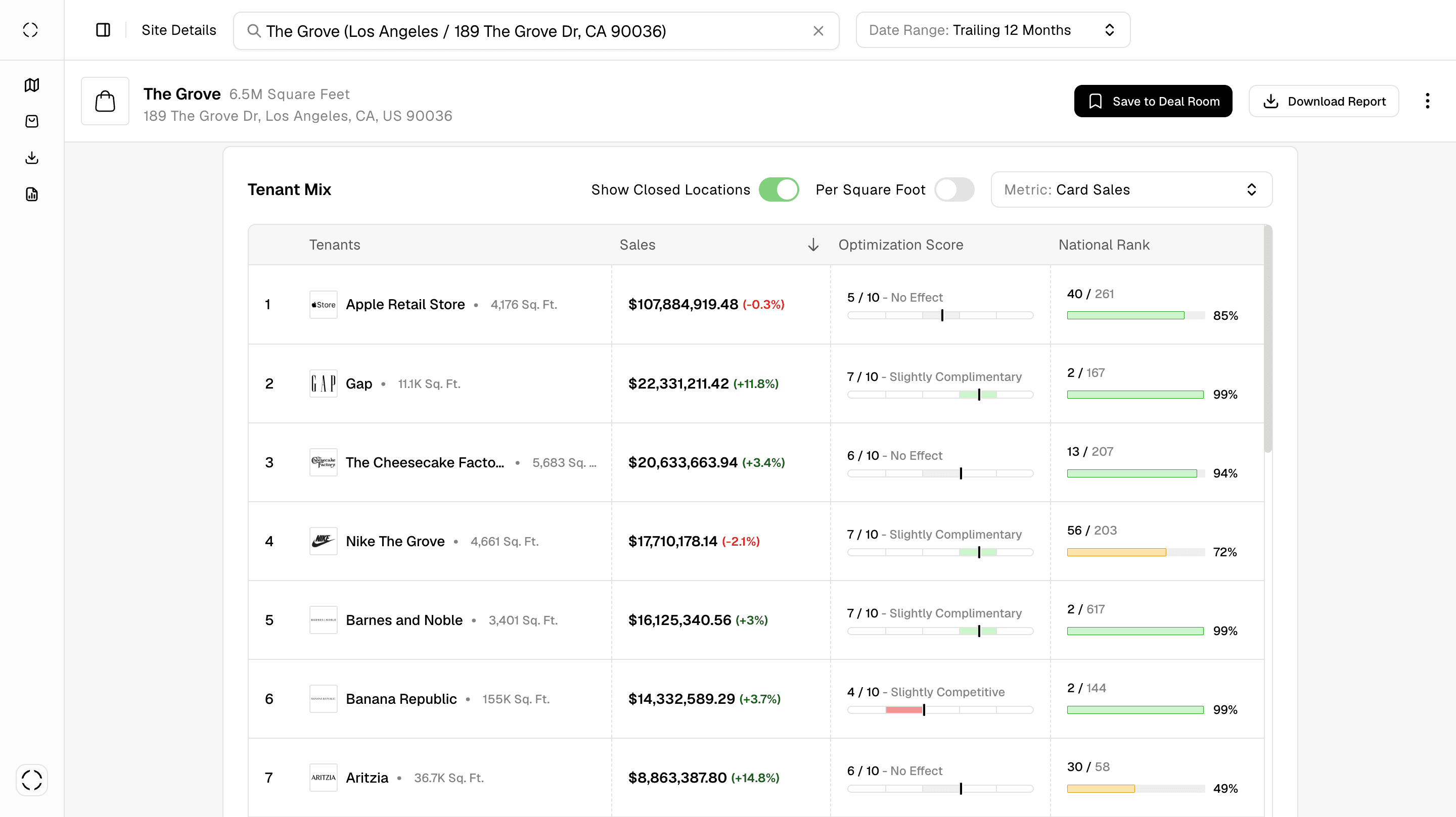
The following chart presents selected tenants displayed in the CenterCheck dashboard. Figures are rounded estimates from the dashboard view and should be interpreted as directional rather than audited financial results.
Apple is the most productive tenant shown in the dashboard, with an estimated $55.4 million in card sales during the measured period. The Cheesecake Factory, Gap, Nike, Barnes & Noble, and Banana Republic also generated meaningful sales.
The chart should not be interpreted solely as a ranking of individual stores. The more important question is what each tenant contributes to the broader center.
Apple may generate a planned visit. The Cheesecake Factory can extend dwell time. Barnes & Noble encourages browsing. Apparel and beauty retailers create additional purchase opportunities. Together, they offer more reasons to visit and more opportunities to convert one trip into several transactions.
Apple Functions as More Than a High-Sales Tenant
The CenterCheck customer-journey analysis provides evidence of how this complementary tenant mix operates.
Customers who visited Apple were also observed moving to Nordstrom, Barnes & Noble, Sephora, The Cheesecake Factory, and other businesses at the property.
That makes Apple’s role broader than its own sales volume.
A productive anchor or destination tenant can create value in at least three ways:
- It generates sales within its own premises.
- It introduces customers to the shopping center.
- It distributes those customers across nearby tenants.
The third contribution is frequently the most difficult to measure, but it can be highly important. A tenant may support the broader property even when the neighboring businesses sell entirely different products.
Apple and Sephora do not compete directly. Apple and The Cheesecake Factory do not share a product category. Yet they may participate in the same customer journey.
That is the difference between tenant adjacency and tenant synergy.
Open-Air Retail Supports a Broader Experience
The Grove’s open-air format also plays a meaningful role in how the property functions.
Open-air centers have gained favor because they can combine shopping with dining, events, public spaces, and social activity. They are not limited to the traditional enclosed-mall experience. JLL has found that outdoor environments have become more popular with shoppers, while Cushman & Wakefield has reported that open-air centers benefit from proximity to residential communities and a diverse mix of services and essential uses.
At The Grove, the environment is designed around more than completing a transaction. The property combines stores, restaurants, entertainment, pedestrian circulation, and gathering space. Its official positioning emphasizes shopping, dining, and lifestyle experiences within an open-air setting.
That environment can help support cross-shopping because the consumer is already moving through the property rather than entering and exiting a single store.
The longer a customer remains engaged with the center, the more opportunities there are for:
- An additional purchase
- An unplanned store visit
- A meal or beverage stop
- A return visit for another purpose
- Exposure to a retailer the customer had not initially intended to visit
The physical design and tenant strategy therefore reinforce one another.
Sales Growth Reflects the Strength of the Ecosystem
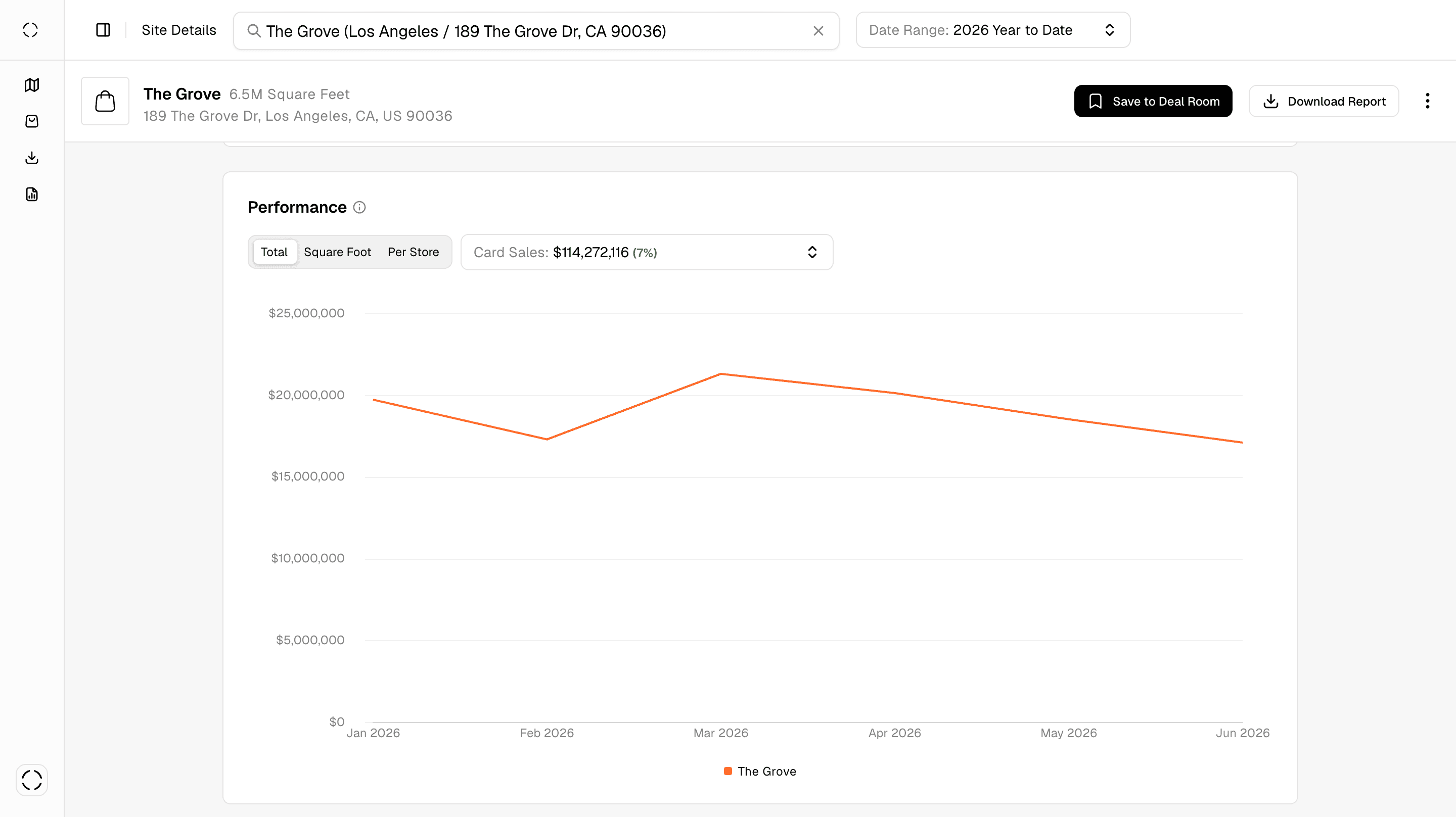
CenterCheck estimates that card sales at The Grove increased from $86 million in H1 2025 to $98 million in H1 2026.
The approximately $12 million increase is significant, but the broader significance is how the sales appear to be distributed across the property.
The dashboard shows substantial productivity from a leading technology tenant, meaningful restaurant activity, several apparel businesses, a bookstore, and other complementary uses.
A shopping center becomes more durable when it can capture spending across multiple consumer missions rather than depending on a single category.
The Grove can serve:
- A planned technology purchase
- An apparel-shopping trip
- A beauty or personal-care visit
- A bookstore visit
- A lunch or dinner occasion
- A broader leisure trip combining several activities
This diversity supports demand. The complementarity converts demand into cross-shopping.
What This Means for Retail Owners
The Grove demonstrates that strong retail performance is rarely the result of one tenant operating in isolation. Its appeal comes from the way the property combines destination retailers, dining, apparel, beauty, books, and entertainment within an environment that encourages customers to stay, explore, and return.
That creates a reinforcing cycle. Productive tenants generate traffic, the broader mix gives customers more reasons to extend their visit, and the property’s strong local customer base supports repeat demand. Together, those factors make the center more attractive to established retailers seeking locations with proven spending power, consistent visitation, and opportunities for cross-shopping.
For retail owners, the lesson is not simply to pursue the biggest brands, but to create a tenant mix in which each business contributes to the strength of the wider property. In a large retail center, a fully complementary mix is rarely realistic. Shoppers value variety, and variety naturally introduces some competition. The goal is to balance that competition with co-tenants that serve different needs, attract overlapping customers, and fit naturally within the same visit.
The Grove also shows why the quality of the overall experience matters. A well-designed open-air environment, a strong surrounding trade area, and complementary uses can help retailers see the property as more than a storefront. It becomes a place where their brand can benefit from the strength of the entire destination.
Retail owners can apply that thinking by focusing on three questions: Does the property give customers multiple reasons to visit? Do the tenants naturally support one another? And does the surrounding market have the spending power and frequency to sustain the mix?
The Grove appears to answer all three well. That helps explain both its retail productivity and its ability to attract leading brands.

Follow Us
Recent Blog Posts
Read the Blog
CenterCheck 2026 Review: Details & Features
25 min read

A&E’s $600M Loan Default Highlights Rent-Regulated CMBS Struggles
10 min read
Spirit Halloween Is Acquiring Hot Topic. Here’s What Retail Owners Should Watch For
10 min read

How Comic-Con 2026 Impacted Retail Sales in San Diego: 10 Findings for Retail Real Estate
10 min read