
What Makes a Good Retail Center? How Midtown Crossing’s Co-Tenants Create Connected Shopping Trips
CenterCheck data suggests that Midtown Crossing’s strength lies in the way everyday retail, services, fitness, beauty, and dining uses support one another—turning a single-purpose visit into a broader shopping journey.
What makes a good retail center?
It is not simply the number of tenants, the size of the property, or the presence of a recognizable anchor. The strongest centers make it easy for customers to accomplish several things during the same visit.
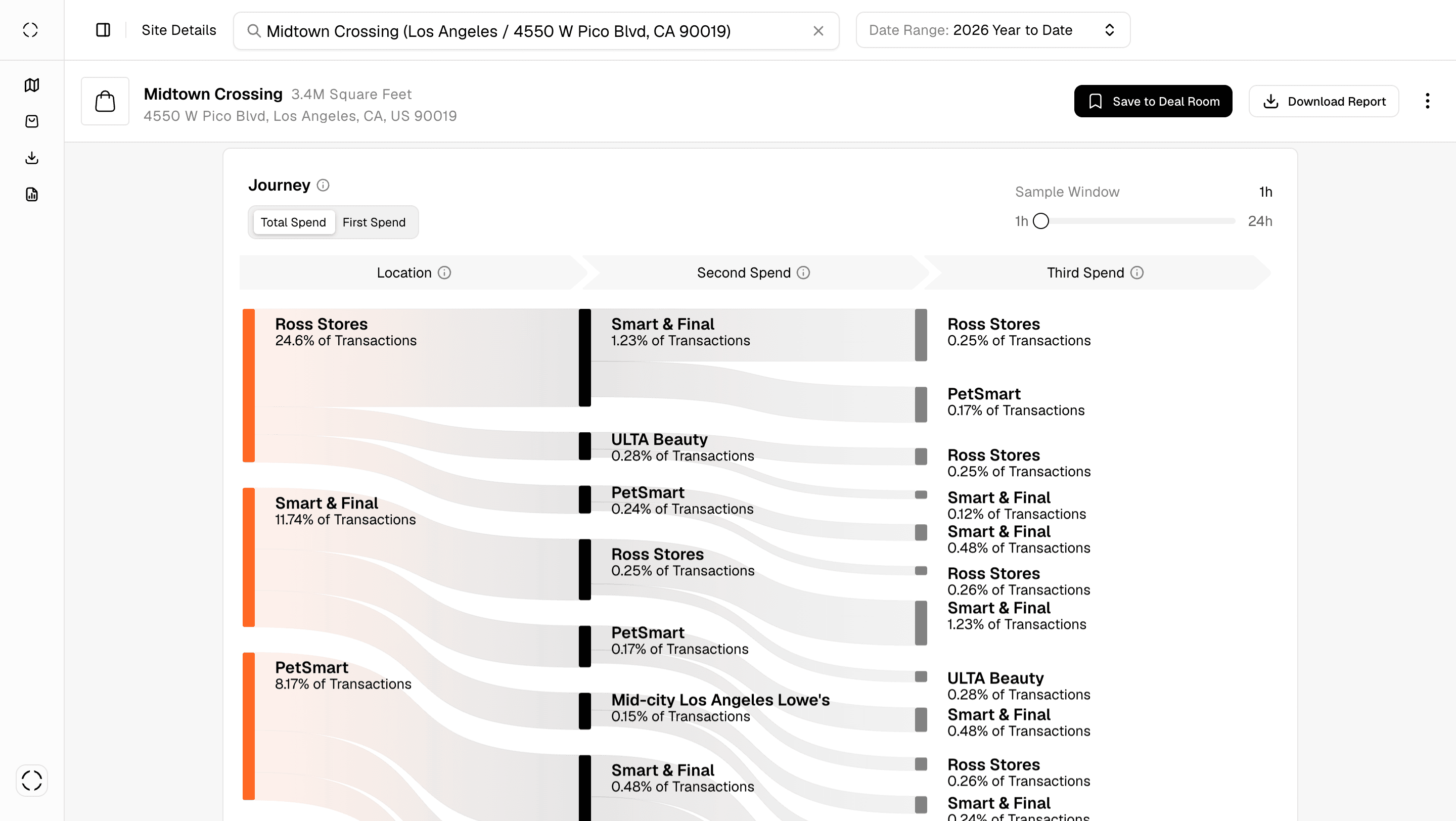
Midtown Crossing in Los Angeles offers a useful example. CenterCheck’s customer-journey data shows shoppers moving between PetSmart, Lowe’s, Smart & Final, Ross Dress for Less, ULTA Beauty, and other businesses across the property. These tenants serve different needs, but they attract overlapping customers and fit naturally within the same trip.
That is what good co-tenancy looks like in practice — not every retailer selling the same product, but each one giving customers another practical reason to stay, explore, and make an additional purchase.
Located at 4550 W. Pico Boulevard, Midtown Crossing is a roughly 315,000-square-foot retail center owned by Blackstone, managed and leased by Perform Properties, and originally developed by CIM Group. Its tenant mix reflects the role that well-located urban retail centers can play in the daily lives of the communities around them.
Midtown Crossing Is Built Around Everyday Consumer Needs
Midtown Crossing is not dependent on a single shopping mission.
Its tenants span several high-frequency and complementary categories:
- Grocery and household essentials
- Home improvement
- Pet care
- Value-oriented apparel
- Beauty and personal care
- Fitness and nutrition
- Restaurants and services
That breadth matters because each category generates demand for a different reason.
A shopper may visit Smart & Final for groceries, Lowe’s for a home project, PetSmart for pet supplies, Ross for apparel, or ULTA Beauty for personal care. The businesses do not necessarily compete for the same purchase, but they can participate in the same customer journey.
For the retail center, that creates more opportunities to capture spending from each visit.
A strong tenant mix is not simply diverse. It is useful.
Co-Tenant Collaboration Is Visible in the Customer Journey
The most compelling insight in the CenterCheck analysis is the relationship between PetSmart and the center’s surrounding tenants.
Customers who visited PetSmart were also observed shopping at businesses including:
- Lowe’s
- Smart & Final
- Ross Dress for Less
- ULTA Beauty
- Other retailers within the center
The pattern suggests that PetSmart functions as more than a stand-alone destination. It brings customers to the property, while the surrounding mix gives those shoppers additional reasons to remain on-site.
This type of cross-shopping can strengthen the entire center.
A customer who arrives for pet food may also purchase groceries, browse apparel, visit a beauty retailer, or stop at a home-improvement store. None of those purchases needs to be directly related to the original reason for visiting.
The value comes from convenience — several relevant businesses are available within one location.
For owners and leasing teams, this is an important distinction. A tenant’s contribution should not be measured only by its own sales. It should also be evaluated by the customers it introduces to the property and the activity it helps generate for neighboring businesses.
The Tenant Mix Balances Frequency and Destination
Statistically, good retail centers typically need both frequent-use tenants and destination tenants.
Frequent-use businesses generate routine visits. Grocery stores, fitness concepts, restaurants, salons, and pet stores can bring customers back weekly—or even several times per week.
Destination tenants generate more intentional trips. Home-improvement stores, major apparel retailers, and specialty businesses may draw customers from a broader area or for a specific purchase.
Midtown Crossing combines both.
Smart & Final supports recurring grocery demand. PetSmart generates repeat visits from pet owners. Lowe’s serves planned home-improvement needs. Ross provides value-oriented discretionary shopping. ULTA Beauty adds a strong beauty and personal-care component.
The result is a property that can accommodate both planned and unplanned spending.
A shopper may arrive with a list for one tenant but leave having visited two or three.
Nearly $91 Million in Card Sales Signals Meaningful Consumer Activity
CenterCheck data indicates that Midtown Crossing generated approximately over $91 million in estimated card sales over the trailing 12-month period shown.
Monthly activity fluctuated across the year, but the broader pattern shows a substantial and recurring level of consumer spending at the property.
That scale is important because it reflects more than one productive store. It suggests that the center is supported by a collection of businesses serving different parts of the customer’s daily life.
The individual tenant data visible in the dashboard also shows meaningful activity across smaller concepts such as Carter’s, Baskin-Robbins, GNC, and Great Clips.
These businesses may not generate the same sales volume as the center’s largest anchors, but they contribute to the center’s utility. A family can shop for children’s apparel, visit a salon, purchase nutrition products, get dessert, and complete larger errands within the same trip.
That mix creates convenience, and convenience supports frequency.
Suggested screenshot placement: Insert the performance chart here to show the property’s estimated trailing 12-month card-sales pattern.
Operating Activity Extends Across Multiple Dayparts
The operating-spend data shows activity building during the morning, strengthening through midday, and continuing into the evening.
This suggests that Midtown Crossing is not dependent on one narrow period of the day.
Different tenants likely contribute to different dayparts:
- Fitness, grocery, and services can generate morning activity.
- Restaurants, errands, and retail support midday visits.
- Grocery, dining, beauty, and discretionary shopping can extend activity into the evening.
For a retail owner, a balanced daypart profile is valuable because it helps distribute demand across the operating day.
A center supported only by lunch traffic, evening dining, or weekend shopping may have long periods of limited activity. A property with grocery, services, fitness, retail, and restaurants can create more consistent circulation.
That broader rhythm benefits both tenants and the property.
The Trade Area Reflects a Diverse Urban Customer Base
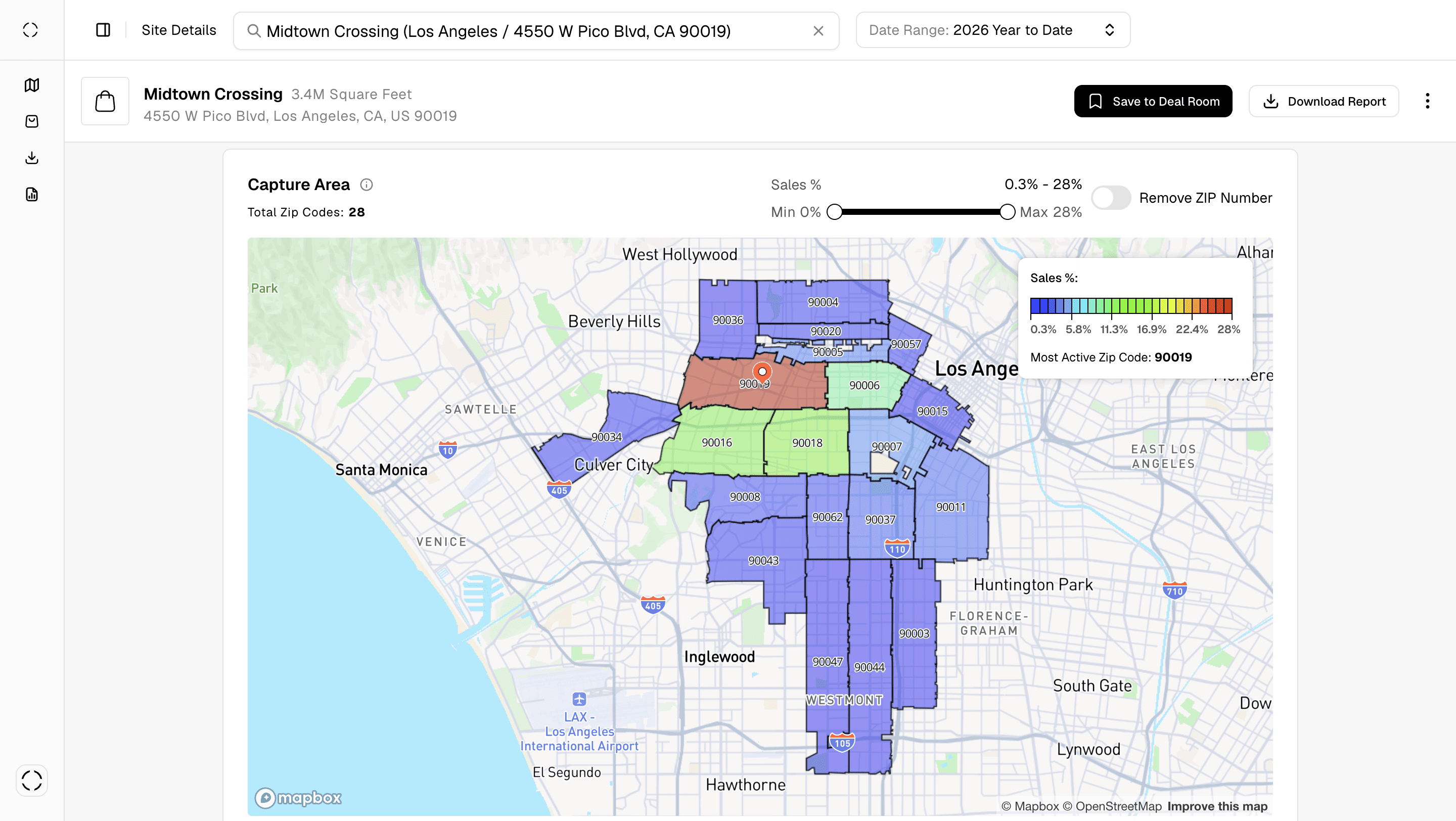
Midtown Crossing draws from a broad area of central Los Angeles, with customer activity visible across surrounding neighborhoods.
The demographic data indicates that its shoppers are more female and have lower reported income and wealth than the immediate local population. The customer base also includes a meaningful concentration of Hispanic consumers.
For retailers, this highlights the importance of looking beyond general census data.
The people who live near a property are not always identical to the customers who actively shop there. Transaction-based insights can reveal the actual consumer profile, helping retailers make more informed decisions about merchandising, pricing, marketing, and store operations.
At Midtown Crossing, the mix of grocery, value apparel, pet care, services, beauty, and home improvement appears well aligned with a broad, practical, and needs-driven customer base.
Why Midtown Crossing’s Co-Tenancy Works
Midtown Crossing’s tenant collaboration works because the property combines businesses that are different enough to create variety but connected enough to serve the same customer.
PetSmart, Lowe’s, Smart & Final, Ross, and ULTA Beauty are not direct substitutes for one another. A purchase at one does not eliminate the need to visit another.
Instead, they address separate parts of the same household’s spending:
- Food and household supplies
- Home maintenance
- Pet care
- Apparel
- Beauty and personal care
This creates natural trip chaining.
The strongest co-tenants do not always sell complementary products in the traditional sense. They may simply serve overlapping customers with different needs.
That is the more useful definition of tenant compatibility.
What This Means for Retail Owners?
Midtown Crossing demonstrates that a good retail center is not created by assembling the largest possible collection of brands. It is created by understanding how customers use the property and selecting tenants that make each visit more valuable.
For large centers, a fully complementary tenant mix is rarely realistic. Shoppers want variety, and variety naturally introduces some competition. The goal is to balance that competition with businesses that serve different needs, attract overlapping customers, and fit naturally within the same trip.
Midtown Crossing appears to do this particularly well.
Its grocery, home-improvement, pet, apparel, beauty, fitness, dining, and service tenants give customers several practical reasons to visit. Its customer-journey data shows that shoppers are not necessarily entering one store and immediately leaving the property. They are moving among co-tenants.
For retail owners and managers, the lesson is to evaluate more than individual tenant performance.

Follow Us
A&E’s $600M Loan Default Highlights Rent-Regulated CMBS Struggles

Spirit Halloween Is Acquiring Hot Topic. Here’s What Retail Owners Should Watch For
How Comic-Con 2026 Impacted Retail Sales in San Diego: 10 Findings for Retail Real Estate

What Makes a Good Retail Center? How The Grove’s Tenant Mix Drives Cross-Shopping
Recent Blog Posts
Read the BlogA&E’s $600M Loan Default Highlights Rent-Regulated CMBS Struggles
10 min read
Spirit Halloween Is Acquiring Hot Topic. Here’s What Retail Owners Should Watch For
10 min read
How Comic-Con 2026 Impacted Retail Sales in San Diego: 10 Findings for Retail Real Estate
10 min read
What Makes a Good Retail Center? How The Grove’s Tenant Mix Drives Cross-Shopping
10 min read