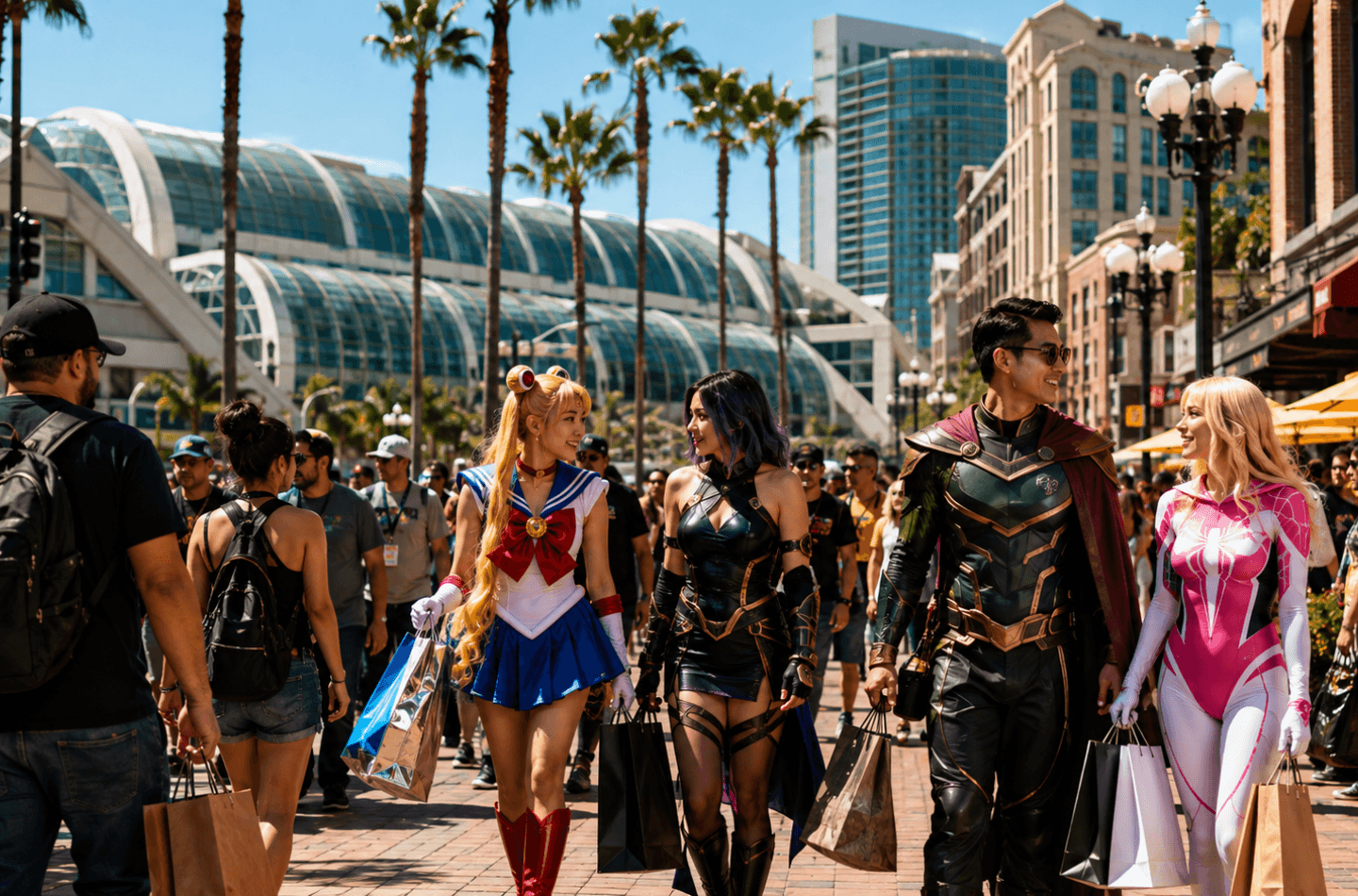
How Comic-Con 2026 Impacted Retail Sales in San Diego: 10 Findings for Retail Real Estate
CenterCheck data shows how Comic-Con changed transaction activity, tenant sales, and the economics of retail locations surrounding the San Diego Convention Center.
Major events can bring tens of thousands of people into a city. For retail real estate owners and investors, however, attendance is only part of the story.
The more important question is: How much of that traffic turns into actual spending?
CenterCheck analyzed anonymized card transaction activity surrounding the San Diego Convention Center during Comic-Con 2026. Within one mile of the venue, transactions increased 55.6% compared with baseline, while estimated card sales increased 37.2%.
The results provide a useful case study for shopping center owners, retail landlords, investors, developers, and brokers trying to understand how major events can affect tenant performance, trade areas, and ultimately real estate value.
Here are 10 findings from the data.
1. Comic-Con Increased Retail Transactions 55.6% Near the Convention Center
Within one mile of the San Diego Convention Center, retail transaction activity increased 55.6% during Comic-Con.
That is significant because it shows the event did more than increase pedestrian activity. Consumers were actively transacting with nearby businesses.
For retail real estate owners, this distinction matters. Foot traffic can indicate demand, but transactions provide a closer look at the economic productivity of that demand.
A property located near an event venue may therefore benefit from something broader than visibility: it may gain access to a recurring source of incremental consumer spending.
2. Estimated Card Sales Increased 37.2%
Transactions increased faster than dollar volume, but estimated card sales still rose 37.2% within the core one-mile trade area.
This suggests Comic-Con materially increased revenue opportunities for surrounding tenants.
From an investment perspective, event-driven sales can matter because tenant sales ultimately influence occupancy costs, rent affordability, percentage-rent opportunities, and long-term tenant health.
For owners underwriting retail near convention centers, stadiums, entertainment districts, and other event venues, annual event calendars may deserve greater consideration as part of location economics.
3. Saturday Was the Strongest Day for Downtown Retail
The economic impact strengthened as Comic-Con progressed.
Transaction lift versus baseline reached:
- Wednesday: +40.2%
- Thursday: +59.5%
- Friday: +61.5%
- Saturday: +69.0%
- Sunday: +46.6%
Saturday produced the largest increase, with 1,386 transactions compared with an 820-transaction baseline.
For landlords and tenants, daily patterns like these can influence staffing, operating hours, merchandising, promotions, and event-specific activation strategies.
The larger implication is that retail performance surrounding major events is not static. Demand can vary materially by event day.
4. Restaurants and Bars Were Among the Biggest Winners
Restaurants and bars experienced some of the strongest gains surrounding Comic-Con.
Transactions increased 116.4%, while estimated card sales increased 93.5%.
This has direct implications for retail leasing.
Food-and-beverage tenants can play an outsized role in capturing event-driven demand because visitors frequently need places to eat, drink, meet, and spend time before and after an event.
For retail owners near high-volume event venues, a strong restaurant mix may therefore create more than experiential value. It can become an economic mechanism for monetizing temporary increases in the trade-area population.
5. “Other Retail” Sales Increased More Than 200%
The broad other-retail category produced one of the most dramatic results.
Transactions increased 121.6%, while estimated sales increased 201.1%.
The performance of IT’SUGAR provides a clear example.
The retailer generated approximately $206,231 in estimated card sales during Comic-Con, compared with roughly $17,002 during baseline.
That represents an estimated sales increase of approximately 1,113%.
For landlords, this highlights the potential value of impulse-driven, experiential, and entertainment-oriented retail concepts near major event generators.
Not every retailer will benefit equally from a crowd. Tenant category and consumer intent matter.
6. The Old Spaghetti Factory Generated Nearly $195,000 in Incremental Sales
The Old Spaghetti Factory at 275 5th Avenue was one of the most notable store-level beneficiaries.
Estimated card sales increased from approximately $44,122 during baseline to $239,221 during Comic-Con.
That represents a 442.2% increase and roughly $195,099 in incremental estimated card sales.
The location sits approximately 0.19 miles from the Convention Center.
For retail investors, this illustrates why proximity can have measurable economic value.
Being close to an event generator may translate into meaningful incremental tenant revenue—and potentially support stronger rent economics.
7. Hotels Generated the Largest Incremental Dollar Gains
Some businesses produced extraordinary percentage growth. Hotels, however, generated some of the largest absolute dollar gains.
Omni Hotels & Resorts generated approximately $1.04 million in estimated card sales, compared with roughly $659,000 during baseline.
That represents approximately $381,586 in incremental sales.
Grand Hyatt generated roughly $1.84 million, approximately $307,234 above baseline.
Outside the immediate core, Hilton Garden Inn generated approximately $291,479 in incremental estimated sales, representing a 179.6% increase.
For mixed-use and urban retail investors, hotel demand can be particularly important because overnight visitors extend the amount of time consumers spend within the surrounding trade area.
That can create spillover demand for restaurants, convenience, grocery, entertainment, and retail.
8. Ralphs Had the Most Transactions in the Core Trade Area
Not every winner was experiential.
Ralphs at 101 G Street recorded 1,901 transactions, the highest transaction count among the core locations analyzed.
Estimated card sales increased from approximately $453,038 to $512,768, a 13.2% increase.
This is important for retail real estate because event-driven demand does not benefit only restaurants, hotels, and entertainment concepts.
Visitors still need everyday goods.
Grocery stores, pharmacies, convenience stores, and other necessity-oriented tenants can become important components of an event district’s retail ecosystem.
9. Convenience and Fast-Food Locations Captured Significant Demand
Comic-Con created substantial spending increases for quick-service and convenience-oriented retailers.
A Subway located approximately 0.23 miles from the Convention Center recorded a 273.2% increase in estimated card sales.
A 7-Eleven at 515 5th Avenue recorded a 275% increase.
Dunkin’ increased estimated card sales 76.7%, while another nearby 7-Eleven increased sales approximately 92.6%.
This may be especially relevant for landlords deciding how to merchandise retail surrounding high-volume pedestrian corridors.
Consumers attending conventions and sporting events often value speed, convenience, portability, and extended hours. Tenant mixes that meet those needs may be positioned to capture more of the temporary demand surge.
10. Major Events Can Change the Economics of Retail Real Estate
The most important takeaway from Comic-Con is not any individual retailer.
It is what the event did to the trade area.
For several days, downtown San Diego experienced a temporary expansion of consumer demand that materially increased transactions and estimated card sales across multiple categories.
That has implications for how retail owners and investors evaluate properties near convention centers, stadiums, arenas, entertainment districts, universities, and other event generators.
Traditionally, underwriting focuses on relatively stable characteristics such as demographics, household income, traffic counts, daytime population, neighboring tenants, and competition.
But some locations have another economic advantage: recurring event-driven demand.
If a property sits near a venue hosting dozens of major events annually, owners should understand how those events affect tenant sales, which categories benefit most, and how far the economic impact extends.
That information can influence tenant mix, leasing strategy, rents, percentage-rent structures, operating hours, temporary activations, and ultimately NOI.
What Comic-Con Means for Retail Real Estate Owners and Investors
Comic-Con 2026 demonstrates why measuring major events only through attendance or foot traffic can miss the more important real estate story.
Within one mile of the San Diego Convention Center, transactions increased 55.6% and estimated card sales increased 37.2%. Restaurants, retailers, hotels, grocery stores, and convenience operators captured that demand in very different ways.
For owners and investors, the opportunity is to identify which tenants can convert event traffic into revenue—and which properties are positioned to capture those economics repeatedly throughout the year.
For brokers, event-driven transaction data can provide another way to quantify location value and support leasing conversations.
For cities, it provides a more granular view of economic impact by showing not simply how many people arrived, but where their money was actually spent.

Follow Us
A&E’s $600M Loan Default Highlights Rent-Regulated CMBS Struggles

Spirit Halloween Is Acquiring Hot Topic. Here’s What Retail Owners Should Watch For
What Makes a Good Retail Center? How Midtown Crossing’s Co-Tenants Create Connected Shopping Trips
What Makes a Good Retail Center? How The Grove’s Tenant Mix Drives Cross-Shopping
Recent Blog Posts
Read the BlogA&E’s $600M Loan Default Highlights Rent-Regulated CMBS Struggles
10 min read
Spirit Halloween Is Acquiring Hot Topic. Here’s What Retail Owners Should Watch For
10 min read
What Makes a Good Retail Center? How Midtown Crossing’s Co-Tenants Create Connected Shopping Trips
10 min read
What Makes a Good Retail Center? How The Grove’s Tenant Mix Drives Cross-Shopping
10 min read